Tuesday, August 31, 2010

[olympiaworkers] RETURN TO WORK AT COKE

OWLS is an open, multiracial, multicultural group of labor activists
formed to forge solidarity across union lines, and to promote the
unionization of all workers, especially the lowest paid.

For more information: www.organizedworkers.org

From: OWLS@riseup.net
Date: Tue, August 31, 2010

Dear friend,

Thanks to all the OWLS activists who showed up on the picket line to
support Teamsters members on strike against COKE. The strike is over for
now, although the push for a fair contract is not. Below is a message
from Teamsters 117 from their website that offers more details.

Also, hope to see you at the King County Labor Day Picnic, Monday,
Sept. 6, Woodland Park, 12 noon. Directions to come. OWLS will have a
table and food, along with other unions and community groups, so come
down and celebrate and gear up for the battles ahead!

Teamsters thank community for support during strike

SEATTLE, WA -- 500 Western Washington Coke employees who went on
strike last Monday will return to work unconditionally in a gesture
that demonstrates their willingness to bargain a fair and equitable
contract in good faith. Negotiations between the Washington Teamsters
United and Coke are set to resume this Wednesday and Thursday,
September 1 and 2.

"Over the last week, we have demonstrated to Coke the value of our
professionalism and our labor," said Blaine Parks, a 32-year driver
for Coke's production and distribution facility in Bellevue. "We have
also sent a strong message to Coke that its employees expect the
company to take the collective bargaining process seriously."

Union representatives expect the 500 area Coke employees will resume
normal operations Tuesday morning to catch up with the backlog created
by last week's work stoppage.

"We are optimistic that Coke will return to negotiations prepared to
bargain in good faith," said Tracey A. Thompson, Secretary-Treasurer
of Teamsters Local 117 and chief negotiator for Washington Teamsters
United. "Issues like the health care for Coke employees and retirees
are too important to our members and their families not to be
addressed in a straightforward and forthright manner."

The Union says it will continue to pursue the Unfair Labor Practice
charges it brought against Coke before the National Labor Relations
Board as well as the class-action ERISA lawsuit on behalf of Coke
employees who had their health care benefits revoked by the company
shortly after the work stoppage began last week.

Approximately 500 Coke employees in Western Washington went on strike
on Monday, August 23, over charges of employee surveillance,
intimidation and bad faith bargaining. Contract negotiations between
the Union and Coke have been underway since April. The employees'
contract expired on May 15, 2010.

Sunday, August 29, 2010

[olympiaworkers] Strike and Picket Update

Dear OWLS activists,
There are some critical labor battles playing out right now in the region. You've no doubt heard about the Teamsters strike at Coke. The stakes are incredibly high, as demonstrated when the Coco-Cola Company canceled workers' health insurance. The workers are fighting to defend their own benefits as well as retiree benefits. The company is demanding an 800% increase in the workers' contribution for health care premiums.

You can make a difference in this fight! Come out to picket line, call the company and tell them to settle the strike (770-989-3000), send messages of solidarity to media outlets, or stop down at the Teamsters Hall (14675 Interurban Ave. S., Tukwila, WA 98168) every Tuesday evening at 5 P.M. for the duration of the strike for phone banking and other volunteer activities. OWLS activists will be going to picket lines in Bellevue Sunday Morning, August 29. If you're interested in joining us, Call Linda 206-819-2279 for more details. Go to www.organizedworkers.org for more information about the strike.

Another group of residents and workers in Washington are also facing severe cutbacks. State offices are being closed 10 days this year, services not provided and employees furloughed without pay. The administrative cost of action is arguably more than the savings-- this is nothing but a political stunt for politicians to beat up on unionized state workers. Workers are taking to the streets on their next day off to protest these cuts.

If you can, please join Department of Social and Health Services workers and OWLS on Tuesday, September 7th, from 1:30 to 4:30, on the 4-stop sign corner of NE 127th & 30th Ave NE, just up the street from Bank of American (on NE 125th) and across the street from the QFC plaza, in Lake City.

From: info@organizedworkers.org
Date: Sat, August 28, 2010

Dear OWLS activists,
There are some critical labor battles playing out right now in the
region. You've no doubt heard about the Teamsters strike at Coke. The
stakes are incredibly high, as demonstrated when the Coco-Cola Company
canceled workers' health insurance. The workers are fighting to defend
their own benefits as well as retiree benefits. The company is
demanding an 800% increase in the workers' contribution for health
care premiums.

You can make a difference in this fight! Come out to picket line, call
the company and tell them to settle the strike (770-989-3000), send
messages of solidarity to media outlets, or stop down at the Teamsters
Hall (14675 Interurban Ave. S., Tukwila, WA 98168) every Tuesday
evening at 5 P.M. for the duration of the strike for phone banking and
other volunteer activities. OWLS activists will be going to picket
lines in Bellevue Sunday Morning, August 29. If you're interested in
joining us, Call Linda 206-819-2279 for more details. Go to
www.organizedworkers.org[1] for more information about the strike.

Another group of residents and workers in Washington are also facing
severe cutbacks. State offices are being closed 10 days this year,
services not provided and employees furloughed without pay. The
administrative cost of action is arguably more than the savings-- this
is nothing but a political stunt for politicians to beat up on
unionized state workers. Workers are taking to the streets on their
next day off to protest these cuts.

If you can, please join Department of Social and Health Services
workers and OWLS on Tuesday, September 7th, from 1:30 to 4:30, on the
4-stop sign corner of NE 127th & 30th Ave NE, just up the street from
Bank of American (on NE 125th) and across the street from the QFC
plaza, in Lake City.

Links:
------
[1] www.organizedworkers.org

Saturday, August 28, 2010

[olympiaworkers] Miners to join South African public sector strike

Libcom.org Aug 27 2010

Miners in South Africa plan to join the massive public sector strike that
has already crippled the the government in recent weeks.

The National Union of Mineworkers said Friday it will join the public
sector strike next week if the government does not meet the demands of
strikers who want more money.

"We are angry that whilst those who are privileged have children go to
school overseas; our children have turned into street kids," the union
said in a statement. "The NUM fully supports the public sector strike and
would next week Thursday ensure that every mining operation, every
construction site and every energy worker joins the public sector strike
in different forms."

Industrial unrest has hit South Africa several times during the past few
weeks as striking public sector workers have halted services across the
country, including at schools and hospitals. Employees have called for
wage rises of more than eight percent and 1,000 rand housing allowances as
part of their demands. The government is offering a seven per cent pay
hike and 630 rand for housing.

But the government says it cannot afford to meet workers' demands and has
ordered military doctors and nurses into dozens of hospitals to protect
vulnerable members of society.

South Africa has been hit hard by the global recession, losing 900,000
jobs last year on top of already high unemployment.

South African labour unions have said that they will cut ties with the
ruling party, and widen a national public sector strike, unless their pay
demands are met. The labour unions were key supporters of the ruling
African National Congress (ANC) and Jacob Zuma, the country's president,
helping him win the last election.

The latest comments by union leaders were some of the strongest signals to
date that organised labour may be ready to cut, or change, its
relationship with the ANC that was forged in the struggle to end
apartheid.

Striking workers have rallied in South Africa's main cities and towns,
including the capital Pretoria, Cape Town, Johannesburg, Limpopo, KwaZulu
Natal and the North West Province among others.

Wednesday, August 25, 2010

[olympiaworkers] Garment and construction workers strikes in Cambodia

Libcom.org Aug 24 2010

In the past few days, a garment workers' strike has found itself in
conflict with bosses, local authorities and union officials while last
week, construction workers struck in solidarity with sacked workmates.

Around 160 garment workers continued to strike on Monday (22nd August)
outside the gates of a factory in Meanchey district, where they have
camped out day and night since Thursday to agitate for improved working
conditions.

Ien Pov, a union representative at the Sun Lu Fong factory, said workers
had made eight demands to the factory's management, including a request
that workers receive US$80 in severance pay for every year they have
worked at the factory.

"Most workers want me to continue to hold the strike after learning that
the factory owner has violated their rights and the law," he said.

But union officials and local authorities say the demands of the workers
may not reflect their rights under labour laws. Som Aun, president of the
Cambodian Labour Union Confederation, said that the severance pay demand
especially was a step too far: "Their demands cannot be settled in just a
short time because what they have demanded is illegal," he said. "This
condition is not mentioned in the Cambodian Labour Law."

Som Aun issued a letter on Saturday calling the strike "illegal" and said
that the confederation had decided in a meeting on August 16th not to
sanction the strike because he wanted to meet with the factory's
management to discuss the workers' demands.

Last week, the Arbitration Council dismissed a complaint filed in July by
160 workers from the factory, citing the illegality of the resignation
clause.

"The factory will discuss their demands and try to solve the problem
outside the court system if the approximately 20 percent of workers who
are on strike agree to go back to work," Som Aun said.

Meanwhile, Keo Sareoun, the chief of Chak Angre Leu commune, said
authorities planned to crack down on the striking workers today: "It is
difficult for us to maintain order and safety at night when such an
anarchic strike is happening," he said. "On Monday, I will not allow them
to protest in the area any longer." He declined to say what measures would
be taken to disperse the protesters.

Ien Pov said that about 20 local police officers had already warned the
protesters. "The police have told us that if we continue to protest our
security cannot be guaranteed," he said.

Construction workers' strike
Last week, about 40 workers went on strike in Kandal province, demanding
that their employers reinstate 27 workers who they say were fired for
trying to organise a union.

Speaking last Tuesday (17th August), Chea Sokyeak, one of the striking
builders, said his colleagues planned to carry the protest into a third
day.

"We will not give up our actions as long as there is no result," Chea
Sokyeak said.

The protesters say the company, KC Gecin Enterprises, fired 27 workers
last Friday because they were trying to form a union. Co-workers began
demonstrating outside the company's headquarters on National Road 2 on
Monday, demanding that the 27 be reinstated. Police officers tore up the
protesters' signs during the protest Monday, though yesterday's
demonstrations were largely peaceful.

Sok Sovanndeth, director of the Cambodian National Federation of Building
and Wood Workers, accused the firm of contravening the country's labour
laws by sacking the 27 employees.

"The company seems to look down on and discriminate against the workers,
since this dismissal took place without any explanation to the workers,"
he said. "They violated the labour laws."

Monday, August 23, 2010

[olympiaworkers] Malaysia: migrant workers protest ends in victory

Libcom.org Aug 23 2010

The migrant workers' protest (previously reported on libcom.org) which
took place at an electronics factory has ended in a resounding victory for
the workers.

More than 5,000 migrant workers of JCY Co. Ltd., an electronics factory in
the Tebrau Industrial area of Johor Baru, protested near the workers'
quarters over the negligence of their employer when a fellow worker died
of high fever while at work. This happened on 16th August when the
employer did not allow him to be taken to hospital in time. It is also
reported that another Nepalese worker also died on 4th August due to lack
of timely treatment.

Migrant workers from Nepal, Myanmar, Vietnam, Bangladesh and India had
united to register their strong protest over the death of their colleague
in that factory. The workers had also highlighted the mistreatment by
management, including low wages and no provision of healthcare facilities
in the factory, which employs around 8,000 workers. About 200 Police and
Federal Reserve Unit personnel were called by management to control the
enraged workers. The determined workers put forward a four-point programme
of demands, including a salary hike, in order to pressurise management
into negotiating, as well as demanding that the Nepalese embassy
intervene.

The three days protest ended in a victory for the workers. Management
agreed to pay compensation of 10,000 Ringgit to the dead worker's family;
increase the minimum monthly salary from 428 to 546 Ringgit; provide an
ambulance service for emergency cases and on time treatment at a clinic on
the factory premises.

The struggle revealed that when workers are united they can win their
demands, even though the employers attempt to use differences in race,
country and religion to 'divide and conquer' workers. Recently, more and
more migrant workers in Malaysia have bravely entered into struggle to
fight for their rights.

This case of exploitation of migrant workers is only the tip of the
iceberg in Malaysia. Most of the more than 3 million migrant workers
(almost 10% of the Malaysian population) earn very low wages, work long
hours and live and work in appalling conditions. According to the Nepalese
embassy, during 2009 a total of 183 Nepalese workers in Malaysia lost
their lives, and another 81 workers in the first six months of this year,
mainly through illness and suicides. There are also many cases of deaths
due to industrial accidents involving migrant workers.

In the meantime, the employers are using low wage migrant workers as a
'threat' to discourage local workers from demanding high wages. The weak
trade unions, with a right-wing reactionary and bureaucratic leadership,
are not capable of playing a role in leading common struggles between
local and migrant workers. At the same time, almost 90 percent of workers
are not unionized, and the government's pro-employer labour and trade
union law further undermines the rights of workers.

Although local workers are given a slightly better deal in wages, when
compared to the high inflation rate their salary is not sufficient to
manage their living expenses. Many are doing two jobs to meet their needs,
and many even end up in the hands of loan sharks when they see no other
way out. Even a recent government survey of about 1.3 million workers has
shown that almost 34 per cent of them earned less than 700 Ringgit a month
- below the poverty line of 720 Ringgit per month.

The multinationals, as well as the national capitalists, have been
establishing their companies and factories in Malaysia to enlarge their
profits. They do not care whether they employ local or foreign workers, as
long as they can suck out the labour of workers to maximize their profits.
Only workers can lend support to other workers for a common class struggle
to liberate themselves from the viciousness of capitalism. An effort to
build fighting trade unions, as well as a mass workers' party, is crucial
towards achieving a society based on needs and genuine democracy without
exploitation that is a socialist society.

Thursday, August 05, 2010

[olympiaworkers] The rage over the wage

Libcom.org Aug 4 2010

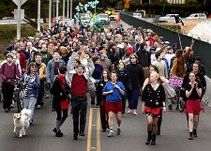
View video about struggle in the garment industry at:

http://libcom.org/history/video-machinists-against-machine-bangladeshi-garment-workers-struggles

Dhaka minimum wage protest - August 2010

The past four days have seen widespread protests and rioting against the
announcement of the new minimum wage structure for Bangladeshi garment
workers.

The industry's monthly minimum wage was last raised after the mass revolt
of 2006. The increase, to Taka 1,662[£15/$23/€18], was already inadequate
- and since then inflation of basic foodstuffs has risen over 70%. While
workers were demanding Tk 5,000[£45/$71/€54], the final offer from the
tripartite negotiations between government, the employers federation BGMEA
and a minority of claimed labour representatives (who have little actual
influence over workers) was Tk 3,000[£27/$42/€32] - an effective wage cut.
Breaking a previous agreement, the increase has also been delayed until
November - thus conveniently missing out the workers' Eid holiday bonuses
due before then. A union leader who opposed acceptance of the increase
said "...in the sixth grade, workers would get paid Tk 3,210 a month and
about 50 per cent of the total apparel workers fall in this grade. Workers
in the seventh grade being promoted to the sixth grade will have an
increase of only Tk 210 in their wages..."

The minimum salary at the entry level has been fixed at Tk 3,000: Tk 2,000
in basic pay, Tk 800 in
house rent and Tk 200 in medical allowance. The apprentice level wage was
fixed at Tk 2,500, up from the present Tk 1,200. The poor spend around 60%
of their income on food to provide a basic two meals a day. How little the
wages will buy can be seen when one compares it with the expenditure of
relatively well paid higher-grade garment workers;

Subarna, an 18-year old lady, works in a garment factory at Mohakhali
in Dhaka city. She is married to a young man who also works in the
same factory and has one cute child: a two-year old son. This 3-member
family lives in a tiny room of tin shed measuring 10 feet by 8 feet
with a low ceiling at a slum area known as "Korail Bosti" ( urban slum
).

"Korail Bosti" ( urban slum ) a huge area near Gulshan where thousands
of garment workers along with thousands of other petty technicians,
day laborers and low-paid servicemen live with their family members in
inconceivable congestion---more than crammed like sardines---in a
multitude of sheds so densely erected that it is hard for one to move
with a handbag stuffed with shopping through any of the narrow
pathways provided in between the sheds. These makeshift houses are
constructed on government-owned land and rented out by some local
musclemen who wield enormous strength to thwart any move from any
quarter to question their right of renting the slum dwellings.

Subarna pays Taka 1,500 for house rent and her other monthly expenses
include Taka 360 for three electric points---one light, one fan and
one television and Taka 200 for cosmetics and toiletries. Her daily
expenses include Taka 42 for 6 Kg firewood, Taka 64 for 2 Kg rice,
Taka 20 for half liter cooking oil, Taka 10 for onion and garlic, Taka
12 for vegetables, Taka 16 for potatoes and occasionally Taka 50 for
fish. One particular expense Subarna hates to defray is on cigarettes
her husband smokes draining Taka 25 every day from her skimpy budget.
Every month Subarna and her husband earn approximately Taka 14,000 and
spend Taka 11,000 for their own consumption and remit Taka 2,000 to
her ailing father living at Charfashion in Bhola.

Union presence in the industry is marginal and the groups have little
function as mediators and negotiators of day to day labour relations. None
of the 'workers' representatives' and 'unions' involved in the wage deal
can claim any very substantial support, membership or validation among the
3.5 million garment workers (85% of whom are female); the majority appear
to not even be garment workers themselves. They are reported as having
been cherry-picked by the government for the negotiations. But some
workers' reps were happy to give the settlement the appearance of
legitimacy and to accept the offer on the workers' behalf;

Nazma Akter, president of Sammilito Garment Sramik Federation, a
platform of 40,000 garment workers, welcomed the announced minimum
wage at Tk 3,000 for the entry-level workers.

Akter, a former garment worker who has gained a foothold on the career
ladder of NGOs and international lobbying has previously been happy to
collaborate with garment bosses and publicly lie to deny any workplace
abuse of garment workers(1). The National Garment Workers Federation(2)
also accepted the offer. Both Federations have condemned violent protests
by garment workers and the NGWF have, absurdly, denied worker involvement.

Emerging from a tripartite meeting, held at Bangladesh Garments
Manufacturing and Exporters' Association building late in the evening,
National Garments Workers' Federation convenor Amirul Huq Amin said
they did not differ with the new wage structure. [...]
'The workers are not involved in the on-going violence in the apparel
industry,' Amirul Huq told reporters after the meeting He called for
identifying and punishing those involved in the recent incidents of
violence. http://www.newagebd.com/2010/aug/02/front.html#3.

The employers - many of whom have become enormously wealthy - admit that
the increase is not a living wage, but plead poverty and ask for patience;

The BGMEA president, Abdus Salam Murshedy, has said garment factory
owners are unable to implement the increased wages of the workers in
next three months as global recession and infrastructural bottlenecks
have affected their business. ... Talking with reporters in his office
on Friday, Murshedy insisted that the factory owners needed some time
to implement the new wages.
'Given the present state of business, the amount of wage increase is
justified,' he admitted. 'We also feel that even the revised wages are
not enough for workers given the increased cost of living; but we
would request them [workers] to give us some time.'

Yet only in May 2010 the BGMEA had stated that business was booming;

... The major buyers, however, have raised the prices of garment
products, especially the knit products, by around 30 per cent in
recent weeks, industry people said.
When asked about the price rise of the RMG products, Mr Mohiuddin said
price rise will actually compensate for the raw materials', including
cottons', prices which went up following production shortfall in the
major growing countries.
The prices of raw cotton remains stable at $1.50 a pound. The price of
30-count yarn also remains stable at $ 3.90 a kilogramme (kg).
The buyers including New Wave of Sweden, Terna of Italy, Wlimp of
Germany, Jerge of Germany, Metro of Germany and Flazeazer of England
have raised the prices of garment products ranging 20 to 30 per cent,
industry people said.
"Buyers have increased prices of the garment products leading to
larger export earnings this year," said Ashraful Hassan, managing
director of Grameen Knit.
The apparel sector fetched $12.59 billion out of the country's total
export worth $14 billion in the last fiscal.
"My buyers who earlier used to pay $1.5 for a piece of T-shirt now are
proposing $2.0 for the same," Mr Ashraf added.
He said buyers have now realised the hardship facing the local garment
manufacturers and started offering better prices.
Industry insiders said 'discount-buyers' who dominate the Bangladeshi
market also started to increase the prices for the RMG products.
Apart from this, the export of apparel goods also increased in April
over the same period in 2009.
EPB data shows that in April, export of knit apparel rose 13.52 per
cent while that of woven products rose around 13.0 per cent during the
period. ...


Dhaka, capital city - last Friday morning (30th July), the day after the
wage announcement ; in the Gulshan, Banani, Kakali, Mahakhali and Tejgaon
areas of the city thousands of workers streamed onto the streets and began
blockading the main highways with burning tyres. Police responded with
teargas, truncheon charges and water cannon (the water is mixed with an
indelible dye to aid catching demonstrators). But, heavily outnumbered,
the cops could not contain the workers and the protests spread outwards.
Making the link between their class status and the contrasting
concentrations of wealth in the city landscape, workers were quite
specific in their targets; as well as attacking garment factories, 200
businesses were targetted. In an unusual development that shocked many,
the wealthy Gulshan Avenue neighbourhood - close to the diplomatic zone
and embassy area of Baridhara - was invaded by 5,000 workers who smashed
up offices, banks and shops. Media and TV offices were also attacked.
"Gulshan police chief said the protesters had targetted the area's
high-end shops."(3)

Garment worker Parvin said, "We were forced to take to the streets as
the owners exploited us right under the government's nose. I have to
spend Tk 1,000 for food and Tk 1,500 for house rent. How will I
maintain other things with this wage?"
"Moreover, the factory owners want to deprive us of the increased Eid
bonus by trying to implement the wage structure from November," she
added.

In the central district of Mohokhali around 3,000 workers attacked
police, stoned factories and blocked a flyover, said local police
chief.
"We have the situation under control, but there are still protests
erupting in other parts of the city," he said, adding that several
factories in his area had been seriously damaged.

Meanwhile, at Tejgaon Industrial Area, protesters broke into a dyeing
factory; massive piles of fabrics were dragged into the road and burnnt to
ashes. At least 20 people, including five cops,were injured in the
clashes.

Late on Friday night police began raids against union leaders. Montu
Ghosh, an elderly labour leader, Communist Party official and Garment
Workers Trade Union Centre adviser was arrested and charged with
instigating workers' protests. Ghosh had been outspoken in opposing the
wage settlement. Several other labour leaders were reported to have also
been arrested. Another indication of the limited influence of these
'leaders' is that their detention had no effect on the intensity of the
protests - except to add calls for their release as another demand.

But in the midst of these struggles, the majority of union leaders -
enticed by being promised (not for the first time) a greater role in
labour relations - have been eager to show their loyalty to the industry;

Earlier, on Sunday night the leaders of 42 labour organizations held a
meeting with Labour Minister, leaders of BGMEA and BKMEA at BGMEA
office in the capital where the labour leaders reassured the
government and garment factory owners that they have accepted the
minimum wage for garment workers and would now work to restore
normality in the garment industry by
Monday.http://newsfrombangladesh.net/view.php?hidRecord=329339

These "unelected" representatives were denounced by 14 other union leaders
for acceptance of the deal.

Despite the prime minister's observation last week that garment wages were
"insufficient and inhuman" - in supporting the miserly increase and
promising repession of those who oppose it, she clearly feels that
sufficiency and humanity are not worth the money;

On Saturday Prime Minister Sheikh Hasina told "workers to accept the
pay hike and return to work", threatening tough action against those
who remain on the streets. ... She said tough action would be taken
against the people who are creating anarchic situation in the garment
sector over the minimum wage.
'We will not spare anyone who is behind this. We will find out the
provocateurs and try them,' Mahbubul Hoque Shakil quoted the prime
minister as having said.


The cops didn't bother to make any pretence of non-political police
impartiality;

Dhaka Metropolitan Police commissioner AKM Shahidul Haque on Friday
warned against any attempts by any quarters to destabilise the
country's garment sector in the name of wage demands.
[...] He said the authorities would show 'zero tolerance' to any
attempts by any quarters to disturb law and order.
Terming practical the new RMG wage structure announced by the
government, the DMP chief urged garment workers and leaders to accept
it.
'We will arrest the persons who are hatching conspiracies to
destabilise the top foreign exchange earning sector. We will find out
the troublemakers and take stern action against them,' he warned.

In the days since, in the various garment factory zones, similar clashes
have continued as workers continue to demand a higher wage. Thousands of
workers have fought police, blocked roads, attacked and looted factories
and forced hundreds to suspend operations, attacked hundreds of
businesses, shopping centres and banks. Massive numbers of armed police
and the para-military Rapid Action Battalion have occupied the garment
areas; but even when prevented from taking to the streets, workers have
stopped work in the factories or not turned up for work. At one factory,
"Witnesses and police said around 1000 workers of Liberty, Metro and Micro
Fibre garment factory staged demonstration inside their factory wearing
red cloth on their head ... to press home their demand." Employers have
also closed many factories, fearing further trouble.

The continued labour unrest and disruption in the garment industry -
alongside infrastructural problems of energy supply shortages that
regularly interrupt maximum productivity - are worrying both foreign
buyers and local suppliers. The narrow national economic dependency on a
single export industry's ability to deliver competitive rock-bottom prices
and reliable fast delivery times means garment workers still have
considerable weaknesses to exploit in the class struggle. The government
and employers may finally - after years of hinting at it whenever labour
unrest reaches a certain peak - begin to allow full trade union
representation in the sector. But the majority of labour leaders, having
now been courted to play the role of giving legitimacy to the miserable
settlement, may have lost more than they've gained. The state and bosses
could easily again break their promises on union recognition - and, as
they continue their struggles, the most militant workers will not look
kindly on the unions' class collaboration and meek acceptance of the poor
wage offer.

Massive deployment of security forces in the industrial belts along with
sweeping raids and arrests have, for the moment, quietened the unrest.
But, with little resolved, the antagonism is set to continue.

NOTES
1) See quotes here;
http://libcom.org/news/bangladesh-carrot-stick-security-forces-fire-garment-workers-government-recalls-unions-1608
2) The US section of the Industrial Workers of the World has cultivated
links with the NGWF - see comments below article here;
http://libcom.org/history/video-machinists-against-machine-bangladeshi-garment-workers-struggles
Like other Bangladeshi 'unions', the NGWF - which itself has close links
with Western NGO's - appears to function more like an NGO than a labour
union.
3) http://www.thebangladeshtoday.com/leading%20news.htm#lead%20news-01

Wednesday, August 04, 2010

[olympiaworkers] Miners in Indonesia strike

Libcom.org Aug 3 2010

Miners at the Batu Hijau mine on the island of Sumbawa in Indonesia are on
strike over unpaid overtime pay, with the union claiming that the strike
is likely to last until the 10th of August.

The strike follows legal wrangling over the company's attempts to withhold
overtime pay owed to 1,919 of its employees. In July, the West Nusa
Tenggara provincial office of the Manpower and Transmigration Ministry
ordered PT Newmont Nusa Tenggara, the company which owns the mine, to pay
$13.8 million in overtime payments, some of which is owing since 2008. The
strike began at midnight following the company announcing its plans to
pursue a legal challenge against the ruling.

PT Newmont Nusa Tenggara is owned by American giants Newmont Mining Co.,
the largest gold producer in the U.S. The mine is Indonesia's second
largest copper mine, and employs over 7,000 people. The company is no
stranger to controversy, particuarly over its environmental record, which
includes dumping waste from the mine into the sea and the rainforest.

Friday, July 30, 2010

[olympiaworkers] Truck Drivers defiant despite conscription orders in Greece

Libcom.org Jul 29 2010

Truck drivers carrying fuel stand their ground and continue their strike
against the austerity measures despite the government calling a civil
conscription on them

The fuel carrying truck drivers strike which started on Monday in response
to a special "reform", part and parcel of the austerity measures, that
will see individual ownership abolished and replaced by large firms, has
been the first strike crisis facing the greek government after the signing
of the EU-IMF structural adjustment agreement. As a result of the strike
at the moment of writing all but a few gas stations across the country
stand dry and shut, with serious problems caused in boat and bus transport
as well as in individual car transport at the peak of the summer exodus
from the cities. The strike is believed to be hampering the tourist
industry which has reported a virtual freeze on reservations from abroad.

The government's response to the strike has been to call the truck drivers
for dialogue on the condition they stop the strike. The truck drivers
refusal to attend such onerous negotiations led yesterday evening the PM
to announce a civil conscription of the drivers and their trucks, an
authoritarian administrative measure equivalent to forced labour in pain
of prison. The truck drivers response has been defiant: last night after
the announcement of civil conscription drivers pulled their trucks to
blockade the oil refineries of Thessaloniki and Aspropyrgos (Athens),
while at the moment of writing a demo outside the Ministry of Transport is
forming in protest to the authoritarian administrative decision. Faced
with resistance the government has not yet used force to force
conscription with truck-driver reps announcing: "We continue. Let them
take us to prison. We have nothing to more to lose. If the government
thinks that after two days of strike it can move to such measures instead
choosing dialogue, it carries all responsibility" .

The response of the Left to the crisis has been bitter. The KKE (Communist
Party) asked in Parliament if the government intends to reopen
exile-island concentration camps for dissidents, while the Radical Left
Coalition has called the conscription a "July coup d' etat" and the
government policy "colonialist". Civil conscription of workers has
occurred again under the Republic at least three times, in 1979 (bank
workers), 1986 (airspace control officers) and 2006 (dock-workers).

Jul 29 2010 13:40
#1
taxikipali

Update: The truck driver demo outside the Ministry of Transport in Athens
was attacked earlier today by riot police forces shooting tear gas against
the protesters. According to mainstream news the lack of fuel has already
led to problems of delivering supplies to supermarkets across the country.
The government is yet to implement civil conscription which could really
derail the situation. According to the news at the moment less than 5 gas
stations in greater Athens hold fuel.

What is civil conscription?

from
http://www.occupiedlondon.org/blog/2010/07/29/341-what-is-civil-conscription/

At this moment, the socialist government of PASOK has just ordered the
so-called "civil conscription" of lorry drivers, who have been on strike
for a fourth consecutive day. International media described this as an
"emergency order", but it is well worth to look a bit deeper into this
measure, as it is now likely that it will concern us time and time again
during the forthcoming winter.

(text below shamelessly copied and translated from corporate media)

What is civil conscription?

Civil conscription (politiki epistratefsi) is the conscription of personal
services, that is, the compulsory provision of personal services of those
conscripted – and it can be called based on Law Decree 17/1974 "Regarding
the Political Planning of State of Emergency". The decree in question
states that a state of emergency is every sudden situation caused either
by physical or other events or anomalies of every kind and which results
in the obstruction and disruption of the country's financial and social
life.

More specifically, article 18 of the 17/1974 Decree allows the civil
conscription of personal in the case of their political mobilisation. The
Decree was issued before the 1975 Constitution and is [therefore] based
upon the Constitution of 1952.

Conscription procedures

Everyone called to offer their services are issued with a "personal invite
to political conscription". The responsibility for the overseeing of this
procedure falls with the local prefectures.

Penalties

Refusing to accept the conscription letter has legal consequences. In this
case, the emergency court procedure is initiated (autoforo) and those who
refuse the letter must be arrested and stand trial. In the case that the
recipient of the letter is absent, the letter must be pasted on their
front-door and the recipients must be immediately located by the police.

Chronicle of civil conscriptions

- 1979- conscription of bank clerks, as their strike had "paralysed" the
banking sector.

- 1983- conscription of the drivers of road tankers.

- 1986- conscription of the flying mechanics of Olympic Airways

- 1994- conscription of the buses of civilians who were co-operating with
the Transport Organisation of Athens

- 2002- civil conscription of the striking dockworkers, following the
serious problems caused by the isolation of the greek islands

- 2006- civil conscription of the striking dockworkers


Jul 30 2010 15:32
#7
taxikipali

Update: In yet another defiant move, the truck drivers have decided today
to continue their strike. The president of the union declared after the
conclusion of the general assembly: "We continue, we have not come here to
mourn our summer vacation leave". The truck drivers are reported to have
hailed the decision in festive mode singing "our president is mad!",
forming a protest march to the Parliament to deliver their decision. The
official announcement of the union underlined: "There is no tomorrow, our
only hope is in the strike".

At the same time the conscription measures have collapsed both due to the
resistance of the truck drivers who are finding ever more ingenious ways
of not being found (the order must be personally delivered) and because of
the masses of paperwork involved having caused the system to collapse upon
its own dead weight. The government has summoned a meeting of national and
local authorities to discuss the implementation of the conscription. The
Coalition of the Radical Left has urged the government to withdraw the law
as the only way out of the crisis. At the time of writing less than 50 gas
stations have remaining fuel reserves in Athens for over 5 million
residents.


Jul 30 2010 20:57
#8
taxikipali

Update3: Clashes erupted late this afternoon between truck drivers and
riot police units in Thessaloniki when the former formed a blockade to
stop a scabbing lorry from taking fuel out of the main oil refinery of the
region. during the clashes 5 strikers were injured. At the same time the
government has announced that it will take all legal measures against the
defiant strikers, including canceling their work permits, while at the
same time mobilising the armed forces to supply petrol to hospitals,
electricity producing units and other public facilities, while the Navy
will try to cover supplies to stranded islands. At the same time the
government is mobilising all its media strings in order to vilify the
strike and excuse its dictatorial measures against it.

Greece turns to military to restore fuel supplies

By DEREK GATOPOULOS, Associated Press Jul 30, 2010

ATHENS, Greece – Greece said Friday it will use military trucks, navy
vessels and commandeered fuel tankers to restore gasoline supplies cut by
a strike that has hurt the country's industry and vital tourism trade at
the height of vacation season.

Government spokesman Giorgos Petalotis told The Associated Press that the
emergency plan would take effect "as quickly as possible" to insure that
vital public services were not affected by the protest, which is in its
fifth day.

Earlier, striking truckers vowed to continue their protest in defiance on
an emergency order to return to work.

Clashes broke out at an oil refinery in northern Greece leaving two people
hurt, police said, after strikers clashed with riot police while trying to
block a government-seized truck from leaving.

Greece is racing to push through austerity measures needed to secure
continued international rescue loans to prop up its debt-strapped economy,
with the next loan installment due in mid-September.

Inspectors from the European Union and International Monetary Fund are
currently in Athens to review progress of cost-cutting reforms.

"The law will be upheld," Petalotis said. "Our information is that most
mobilization notices have now been handed out. Those who do not comply are
violating the law and can lose their operating license and face the
consequences of criminal prosecution."

The truckers have rejected a compromise offer by the government to offset
the financial impact of liberalizing their closed-shop profession.
Click image to see photos of clash in Athens

Reuters

Sweeping labor reforms targeting previously protected professional groups
follow months of strikes and protests over other belt-tightening measures
that included sale tax hikes, and cuts in pensions and civil service pay
â€" all in the midst of recession that has seen unemployment spike to
around 12 percent.

The fuel strike has hurt Greek industry and tourism, with shortages likely
to affect travel this weekend.

"This is a catastrophe. The decision was taken on the busiest day of the
year, at peak season ... I don't know what's worse, what is actually
happening today or the bad publicity this is giving us," George Telonis,
head of the Greek Association of Travel and Tourist Agencies, told The
Associated Press.

"The season so far has not gone too badly, with about a 3 percent drop on
the year, despite all the strikes and difficulties ... because we have a
very strong product. But I am very worried that damage will be done if
this strike continues," he added.

He said the fuel strike will hammer last-minute bookings and popular
holiday excursions to beaches and ancient sites.

Hoteliers at resorts in northern Greece, which are mostly accessed by car,
have reported a steeper drop in bookings this year — more than 15 percent,
according to their associations.

"We are helping customers find open gas stations so that they can get
home," said Grigoris Tasios, head of the Halkidiki Hotel Association, of
resorts in northern Greece. "About one or two gas stations are currently
supplied in a 50-kilometer (30-mile) radius, when normally there would be
at least 10."

George Amvrazis, managing director of the Greek Hotel Federation, said the
strikes had already tarnished Greece's image.

"This has taken a toll on mainland resorts. You won't set out to a resort
if you're not sure if you can fill up your gas tank," Amvrazis said. "This
current protest, together with all the others, has set the Greece brand
back for years."

Friday, July 23, 2010

[olympiaworkers] Don't Mourn, Organize (Puget Sound area grocery workers)

From: info@organizedworkers.org (OWLS)
Date: Thu, July 22, 2010 9:46 pm

Dear friend of working people,

What do grocery clerks, school bus drivers, and employees at
Seattle Housing Authority have in common? They are all living the
advice of famous labor agitator Mother Jones who urged workers to
organize, and not accept low wages and lousy working conditions.

Learn about efforts to win union representation at First
Student, and a fair contract for 21,000 Puget Sound area grocery
workers at QFC, Fred Meyer, Albertson?s, Safeway, Metropolitan Market
and independent stores, represented by United Food and Commercial
Workers (UFCW) Local 21. Their contract, bargained by Local 21,
expired in May and is in "extension." So far, there is no real
progress in coming to a fair and just settlement. Also, the grocery
workers "BILL OF RIGHTS" will be presented and available in petition
form for all who want to sign on their support. More than 41,000
residents and grocery workers from across Puget Sound have signed on
to this important initiative that will ultimately be presented to the
corporations at bargaining sessions. Be a part of the action!!

Bring news of your own labor campaign, and join rank-and-file
labor activists in a discussion on how to collaborate and coordinate
efforts to strengthen workers rights throughout Puget Sound at the
next meeting of Organized Workers for Labor Solidarity.

TUESDAY, JULY 27, 7PM AT THE SEATTLE LABOR TEMPLE, 2800 FIRST AVE.,
HALL #6

Monday, July 12, 2010

[olympiaworkers] A new book by a Wobbly

Please forward to other lists

Greetings All,

   Black Cat Publishers has just finished publishing a book I wrote called "Yardbird Blues; 25 Years of a Wobbly in the Maritime Industry". The term "Yardbird" is an old term that longshore workers and ship's crews used for those that came on to the ships to repair them.  

  The book is about real workplace experiences and issues in the maritime industry such as: workplace safety, general working conditions, environmentalism and how to begin to make earth safe ships, the bosses, the unions, different types of ships, the great danger to workers and the environment of FOC ships and more. All that from the viewpoint of a Wobbly shipyard worker..

  The chapters are: The Blues; The Making of a Yardbird; Down Houston Way; Types of Maritime Vessels; Making Dreams Real; Blues Again; Green's Bayou; Improving Goods; Asbestos, the Dust of Death, Speed Up and Die!; Working on the Mississippi River and Louisiana Jack; The 1985 New Orleans Waterfront Metal Trades Strike; Pains in My Wrists; Meeting Up with Todd Again; It's a Love Boat!; Fire on the Water; Such a Foolish Notion; Environmentalism and the Maritime Industry; In the Belly of a Love Boat, or I got them Old Fireroom Blues Again; Greed Upon the Oceans: Flag of Convenience Ships; Spiraling Downwards; Screwed Again; Dignity of Labor; What is the Value of a Worker's Life?; Health Care Should Be a Right, Not a Privilege; The IWW Centennial: One Shipyard Worker's Perspective.

  A number of parts of this book were articles that have been published in the IW, Bayou La Rose and other publications. The introduction was written by FW Carlos Cortez before he passed away.

  The book can be ordered for $12.00 from::Bulk copies are $7.00

Black Cat Press                                                          4508 118 Avenue                                                 Edmonton, Alberta, Canada T5W 1A9 blackcatpress@shawbiz.ca                    www.blackcatpress.ca

  I wish to thank the people at Black Cat Press for publishing this book and the hard work they put into making it look so good.

  This is the first book in a series of books that I hope to get published. The next one is in its final draft and was edited by Tacoma GMB Branch Secretary Leah Coakley. That book deals with other industries. After that one there may be a book on the modern IWW. That book would include my experiences in the IWW for 40 years and IWW related writings included: Organizing Solidarity, Duel Unionism, A New Union Vision, International Industrial Unionism, A Union For All Workers, Green Unionism, Organizing Tips, and more. Some of these essays have been rewritten from how they were before. It will be made clear in the introduction that this is just the writings of one Wobbly for only "A New Union Vision" was ever approved as official, though other pieces were approved by the Tacoma GMB. For those of you who like to worry about such things, none of this includes any of our internal conflicts.

  I base my writing on what I was taught by some old time Wobblies, in particular, FW Gibert Mers who encouraged me to write about what I know best. His book "Working the Waterfront" was a good example of writing about direct workplace experiences.

  The real purpose of my writting is not to get my views as an individual published, but rather to try to help encourage working people to speak for ourselves and to write about our direct workplace experiences. I believe strongly that this is a very important part in worker self-organization. Too often workers are talked down to as if we are just sheep to be led and that our only role is to be followers. I believe workers do understand our class situation and we understand industry and how to change it better than any would be leaders and that real workers' self-organization, that we control, is the only means to reach worker self-management. And to do that workers must speak for ourselves. Me, I am nothing more than a rebel Wobbly shipyard worker. 

  Many Wobblies have helped me over the years with my writings by proofreading, editing and making useful comments. I wish to acknowledge them and thank them for the help. And I wish to thank the IWW for being something that I could believe in and I will stay with the IWW until I pass from this world.

For The OBU

Arthur J. Miller

Ship Builders IU 320