Thursday, September 24, 2009

[olympiaworkers] Staff, students to walkout at 10 University of California Campuses

Sep 24 2009 libcom.org

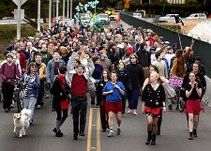
In an effort to protest education cuts, students and staff at ten
University of California campuses will stage a walkout on 24 September
2009.

University of California administrators say they want to keep things
running as smoothly as possible Thursday -- the first day of school at
many campuses -- when many faculty, staff members and students are
expected to walk out of classes, host rallies and stage a systemwide labor
strike for technical employees.

UC is facing one of the worst years in its history as it tries to close a
budget gap of more than $750 million in lost revenue from the state and
increased expenses. To balance the budget, administrators have ordered
unpaid furloughs for nonunion employees, staff layoffs and course
cutbacks, and are expected to raise tuition for next year, making it 45
percent higher than last year's student fees.

Those actions have infuriated employees and students.

"There is a lot of anger and frustration, and people need to vent that,"
said Dan Mogulof, a spokesman for UC Berkeley, where classes have been in
session for a month. "The main concern is that the faculty are expected to
meet their obligations to students -- giving them notice about course
cancellations and changes, and making sure that the course material is
covered."

It's a sentiment echoed by administrators across the 10-campus system. The
last thing they want Thursday are empty classrooms -- or rooms filled with
students with no one at the podium to teach them. But it's a possibility
on many campuses.

Since late August, some UC faculty members have been urging all
instructors to walk off the job Sept. 24 to protest the university's
handling of its crisis and a policy that furlough days not be taken on
days they teach. More than 1,000 professors and associate professors
across all campuses have signed a petition urging the walkout.
Other faculty members at UC Berkeley have taken a different approach,
forming a group called Save the University. They support their colleagues
who plan to walk out, but will hold educational forums on UC's financial
troubles from the perspective that there are better ways to bolster the
university.

Even so, many of the same faculty members may cancel classes or hold them
off campus to avoid crossing a picket line by the University Professional
and Technical Employees union, which plans a one-day strike because it has
been working without a contract for 18 months.

Meanwhile, some student groups have issued statements in support of their
instructors.

Amid all of this, campus administrators say they are hoping for business
as usual.

"I think that most of our classes will go off without a hitch," said
Patricia Turner, vice provost for undergraduate studies at UC Davis, which
starts school Thursday.

"We completely support freedom of speech," she added.

It's a message the campuses are sending to the protesters -- even as they
urge students and faculty to go to class.

"I understand that on some campuses, including ours, labor actions could
impact the opening of classes this Thursday," UC Santa Cruz Provost David
Kliger said in a message to all employees sent Monday. "I hope that those
who participate in this action try to minimize disruption to our students
-- the people we are here to serve."

Some faculty members want a different message.

"I'd like them to talk to the students who are going to have to drop out
because they can't meet the (expected) tuition increases," said Shannon
Steen, a UC Berkeley associate professor of theater. "These are the
students who are going to be hurt the most."

The resolution of the University of California Students Association
supporting the action can be found here:
http://www.ucsa.org/board/resolutions/UC%20Walk%20Out%20Resolution%20Final.pdf

An interview with one of the professors who will be taking part in the
walkout can be found here:
http://www.npr.org/templates/story/story.php?storyId=113114099

Monday, September 21, 2009

[olympiaworkers] New Zealand Dairy Workers Locked Out

Libcom.org Sep 20 2009

New Zealand company Open Country Cheese, part-owned by Talleys and tied to
various National Party MPs via New Zealand's Dairy Investment Fund and
Kaimai, is fighting dirty in an attempt to break workers seeking a
collective agreement with basic redundancy and transfer of undertakings
protection.

From Aotearoa Indymedia:

"There is no wage increase on the table. Workers are seeking a collective
agreement which protects them from being made temporary or casual at any
time. They want a say on how their rosters and hours of work can be
changed so their family lives are not disrupted without notice and
consultation. They want temp workers to be paid the same rate for the job
after 3 months. They want temp workers to be made permanent after 11
months service. They want redundancy compensation if made redundant and
they want to be paid for a meal break if they can't leave the plant. –
Most of all they want to be treated as human beings- not a commodity to be
tossed aside when no longer required. They want decent jobs."

Dairy Workers Union National Secretary James Ritchie has stated:

"Our members at Open Country Cheese were escorted off the site today
(Wednesday) 5 hours before the strike was to begin. The Company has re-
registered as a different company and is now the company that operates
plants at Invercargill and Whanganui. It is Talleys by any other name.
There are various legal permutations of this and we are considering our
response. Strikebreakers have been transported from Invercargill and
Whanganui."

And from Scoop:

"Talleys-owned Open Country Cheese's insistence on running their plant
without appropriate trained environmental staff is now causing serious
environmental damage," said James Ritchie, National Secretary of the Dairy
Workers Union.

36 workers are in their third day of strike action at Open Country
Cheese's Waharoa plant in Waikato, after the company has refused to
negotiate a collective agreement and protect workers' job security.
Untrained staff are now operating the plant.

Today the environmental ponds overflowed with deactivated sludge and
poured into the river. The sludge tanks need to be managed by trained
staff and is a critical part of the manufacturing process.

Nomally the sludge is collected by trucks and spread on farms – but we
found out this morning that it had been poured directly into the Waitoa
river."

This dispute is being viewed as a major attack on the right to join a
union and collectively bargain. The employer is openly organising
strikebreakers and encouraging farmers to get involved in the dispute.
This dispute has all the hallmarks of a major conflict.

There is a picket running from 5.30am to 6pm each day at (outside the Open
Country Cheese plant at Waharoa just north of Matamata on the main
Auckland to Rotorua/Tauranga highway). The Dairy Workers Union will be
collecting food and money in support.

Friday, September 11, 2009

[olympiaworkers] Subway workers hold 'no fare' protest and strike in Buenas Aires

Libcom.org Sep 11 2009

This week employees on the Buenas Aires subway freed turnstiles for two
hours in a move to press the government to grant legal status to their
recently created trade union as well as taking strike action.

According to Argentine law only one union on each trade or activity can be
granted legal status and therefore, participate in wage bargaining or
legally call for a strike.

The spokesman of the workers, Néstor Segovia, said in a radio interview
that the union "is demanding that the Labor Ministry grants legal status"
to the subway workers union, whose workers last year voted in favour of
creating a new union as a result of differences with the UTA transport
workers union which now gathers all workers in the transport activity.

UTA claims the initiative would go against the law, as it goes against
their interests. Nevertheless, a ruling of the Supreme Court last year
paved the way for changes in the law in a move to democratize labor
unions.

Another union representative, Roberto Pianelli, later in the week told the
press that workers will also be taking strike action which will interrupt
service on all subway lines from noon till 2pm, but said that workers
wanted to "avoid" the strike and that they waited up to the last minute to
call it off.

Pianelli said that if before noon they get a phone call to begin solving
the problem of the legal recognition of a trade union of subway workers
independent from the larger Transportation Workers Union (UTA) then they
may reconsider. However, the delegate never received that call and the
strike began at 12 pm sharp on all six lines of Buenos Aires city subway.

Company officials said the strike would affect 160,000 passengers.

Tuesday, September 08, 2009

[olympiaworkers] Kent teachers vote to stay on strike despite judge's order

Story Updated: Sep 7, 2009
By KOMO Staff & News Services

KENT, Wash. -- Teachers in Washington state's fourth-largest district
voted Monday night to continue their strike, despite a court injunction
ordering them back to work Tuesday to prepare for students.

Kent Education Association spokesman Dale Folkerts said 74 percent of the
1,300 gathered union members voted not to return to work until they have a
ratified contract.

The teachers "know there could be consequences" to going against the
judge's order, he said. But after a long and heartfelt discussion, "they
decided it was a cause that was important enough to stand up for."

Choosing to break the law, the teachers themselves weren't quite sure what
would come next.

"I don't know. Maybe come down and visit us in jail," said teacher Ron
Colston.

"I suppose there's a whole slew of issues that could arise of these
consequences," said union president Lisa Brackin-Johnson. "Our members
have said they are willing to go (to jail).They made their vote today.
This is what they're willing to do."

The teachers are unwilling to settle on their top issues -- class sizes
and more time with students.

Folkerts said class-size limits in Kent are substantially larger than
surrounding districts and that overcrowded classrooms create bad learning
environments and in some cases, safety risks.

"Today we made a statement that says, 'No more; we've had enough.' And I'm
very proud of our association for that," said teacher Demetrius Pye.

"You know, I've always told my children to obey the law. But sometimes
laws need to be changed," said teacher Donna Pearson.

Before Monday night's vote, hundreds of families and students gathered to
cheer on the teachers in their fight.

"We want quality education. That's what this is about," said parent Tom
Curtis. "And we're here to support teachers, and they have to be really
courageous at this time."

"Watched the teachers working with the students. I've seen how they're
suffering with over-sized classrooms, and not having enough funding for
supplies in the classrooms to the point where the teachers are asking us
for tissue boxes for classrooms," said parent Vipul Rathod.

The Kent School District has more than 26,000 students and 1,700 teachers
at 40 schools. Its teachers began their strike Aug. 27, less than a week
before classes were scheduled to begin.

On Thursday, King County Superior Court Judge Andrea Darvas granted the
district's request for an injunction to force the teachers back to school,
saying their strike was illegal. She encouraged both sides to continue
bargaining.

District spokeswoman Becky Hanks said late Monday that the district's
bargaining team was prepared to negotiate throughout the night for the
first time since the teachers' strike began.

She said the district is working to address teachers' concerns while being
fiscally responsible, and has put forth a proposal that raises pay,
decreases meeting time, and increases the staff-to-student ratio by
bringing in extra assistants and placing limits on class size.

"The bottom line is, we have absolutely addressed each of their requests,
and we hope that our teachers have a chance to review the district's
proposal," Hanks said. "We want our students back in school where they
belong, and we believe we've presented a fair proposal that responds to
their requests."

Monday, September 07, 2009

[olympiaworkers] Coal miners strike in Hunan, Central China

libcom.org Sep 7 2009

Up to 5,000 workers at four coal mines in Hunan Province, Central China,
have been on strike since the 22nd of August over new contracts.

The mines belong to the Jinzhushan Mining Industry of Hunan Coal Group
(Xiang Mei Ji Tuan, XMJT), which proposed being privatized and being
listed on the stock market. In doing so it demanded workers sign
agreements waiving the legally required compensation of one month's pay
for each of their previous years of work – over 30 years in some cases –
before allowing them to resume work.

Speaking to US-based Epoch Times a family member of one of the strikers
explained:
Quote:

Workers think the new contract is unfair as it includes no financial
compensation for one's previous years of work. All the workers are now
unwilling to sign the new contract. A miner who had worked for years
and was now ready to retire would get no compensation according to the
terms of the contract.

Workers at the Jinzhushan mine refused to sign the agreement and after
colleagues at the other three mines were informed, they all went on
strike, as workers told media:
Quote:

Workers from four mines are on strike and haven't reported to work
since the strike began. They want compensation for their years of
work; otherwise they are not going to sign.

Third strike in a month

It is the third strike over a privatization of a State Owned Enterprise in
just over a month, and workers appeared well informed about the other two
instances. The Hong Kong-based South China Post reported one worker as
saying:
Quote:

We have not beaten anyone, we have not detained anyone, and we have
not destroyed any company property. All we want is an answer.

This seems an allusion to the strikes Tonghua Iron and Steel, in which a
senior manager was killed (reported on libcom [url=
http://libcom.org/news/workers-beat-capitalist-death-26072009]here[/url]),
and Linzhou Iron and Steel, involving the holding of a manager hostage for
several days (see reports here and here). Both strikes ended with workers'
demands being met.

Attempts by workers to contact mainland media have been rejected, only
Hong Kong and US based media reporting on the situation. Posts on mainland
Chinese blogs were also swiftly deleted.

Company forming "Mine Protection Brigade"

In an effort to prevent an escalation of the dispute local government
officials are currently negotiating with both managers and workers.
However, workers stated that the company had recruited local thugs at 200
yuan per person per day to form a "mine protection corps" to remove
strikers from the mine premises by force.

Despite a swift order from the local government to disband the corps, they
also warned strikers that they face arrest if they do not call off the
strike soon. Officials were probably trying to avoid a repeat of events at
another state-owned mine in Hunan two years' earlier when a peaceful
protest became a full-scale battle between miners and security forces,
reported on the Hong Kong-based China Labour Bulletin:
Quote:

On 8 August 2007, more than 800 mineworkers at the Tanjiashan mine in
Xiangtan staged a strike over arrears in the payment of final
severance packages and social security contributions. Early in the
morning of 15 August, more than 200 temporary security guards used
physical force to break up the strike. The miners retaliated and in
the ensuing mêlée at least one miner and a security guard were killed.
Over 20 other people were injured, and two police cars destroyed by
the enraged workers.

Since the 2nd of September no further news has come out on the progress of
the strike, although The Epoch Times reported yesterday on a strike at a
Philips respiratory factory in Shenzhen over changes the work time and
general conditions of work here. Factory management called the police who
immediately began beating workers when they arrived, forcing the strike to
be called off.

Thursday, August 27, 2009

[olympiaworkers] Sydney bus drivers defy union and take wildcat action

Libcom.org Aug 27 2009

A six-hour strike by 130 bus drivers in western Sydney on Monday morning,
carried out in defiance of their union, has produced furious denunciations
in the media and from an industrial court judge. The drivers walked out at
the Busways Blacktown depot at 3.30 a.m. against the imposition of new
timetables that would impose shorter times for routes.

Drivers said that the timetables, due to commence in October, would be
impossible to meet, forcing them to run late, which would not only
inconvenience and anger passengers but cut short the drivers' break
periods. The workers said they would be under enormous pressure to drive
over the speed limit.

Months of trade union talks with the company have failed to halt the
onerous new conditions. Angered by the lack of support from the Transport
Workers Union (TWU), the drivers conducted their own stoppage, giving no
warning to the union or management. The TWU opposed the strike and
intervened to end it as quickly as possible.

Drivers said the timetables would add to Sydney's public transport
shambles, which has seen the state Labor government in New South Wales cut
the frequency of rail services and scrap plans to extend the rail network
to new outlying suburbs. In many outer western and southern suburbs, the
so-called public transport system depends almost entirely on heavily
government-subsidised private bus companies.

The Busways Group is a large private operator, holding lucrative state
government contracts to run more than 600 buses, and employ more than 700
drivers, on approximately 100 routes in the Sydney and New South Wales
Central Coast regions, and around 30 more in the state's mid-North Coast
area.

Like employers across the board, Busways is utilising the economic crisis,
with the backing of the state government, to demand a productivity
speed-up. With unemployment continuing to rise throughout Sydney's
western, working class suburbs, the company is actively recruiting drivers
willing to accept the new conditions.

The mass media launched a scathing attack on the drivers for halting
services from the depot during the morning peak period, claiming that
their actions had seriously disrupted and traumatised commuters, as well
as school children and parents. As drivers pointed out, this was sheer
hypocrisy as passengers were frequently left stranded by delays caused by
the existing, already over-stretched timetables.

What really provoked the media's wrath was that the drivers had defied the
TWU and taken matters into their own hands. The tabloid Daily Telegraph
labeled them "rogue drivers" who had acted "without consulting any
official of the Transport Workers Union". An editorial declared that a
"bolshie minority" had staged a "wildcat strike" because their "tempers
led them to ignore even the instructions from their own union".

In the state Industrial Relations Commission, Justice Frank Marks accused
the drivers of "industrial thuggery of the worst kind ... in the face of
opposition from their elected delegate and without consulting any paid TWU
official". The judge ordered the TWU and its members not to take any
further industrial action over the timetable.

The response betrays considerable nervousness on the part of the official
establishment that the drivers could set an example that would encourage
other sections of workers to defy the trade unions and take independent
action to defend their jobs and conditions. Over the past three decades,
the unions have been the essential instrument in sabotaging any resistance
by the working class to the pro-market agenda imposed by successive
Coalition and Labor governments on behalf of big business.

During the past year, as the global recession has deepened, the TWU and
its counterparts throughout the union movement have worked hand in hand
with the Rudd Labor government to help companies large and small impose
far-reaching cuts to jobs, working hours and conditions.

The reaction to a relatively small wildcat strike by Busways drivers
reveals just how reliant governments and big business are on the unions.
The reference to "bolshie" workers—that is, drawing a parallel between the
Busways drivers and the Bolsheviks who took power in Russia in
1917—reveals the growing concerns within ruling circles over the
consequences of sharpening social tensions produced by worsening
unemployment and deteriorating living standards.

Like other sections of the working class, private bus drivers have been
forced to sacrifice pay and conditions. After years of TWU complicity in
the introduction of "flexible" conditions, drivers now receive virtually
no penalty rates, regardless of how early, late or broken their shifts.
Despite the intense pressure of constantly driving in heavy traffic, and
being responsible for the safety of thousands of passengers daily, they
are paid base rates of just $50,000 or so a year.

By contrast, the Rowe family, which owns the Busways Group, is thought to
be one of the wealthiest in Australia. The extent of its profits, and the
government subsidies it receives, is shrouded in secrecy.

Although the Busways management has now agreed to further talks on the
proposed timetables, and despite judge Marks's no-strike order, drivers
said they would strike again unless the company dropped its demands. The
TWU, on the other hand, has worked to isolate the Blacktown depot drivers,
even from the workers at the company's 15 other depots, let alone other
bus drivers and transport workers, all of whom face similar attacks.

One driver, who has worked for Busways for 10 years, said: "We acted out
of frustration after 10 years of fighting oppressive and deficient
timetables. The new timetables will be a nightmare. The TWU did not
condone the strike, and said we could be fined $50,000. It's like a
dictatorship.

"The union is useless, and there's nowhere for drivers to go. The
government pays the private bus companies by contracts and it wants us to
be slaves—it doesn't want us to be paid better.

"I am very dubious toward the union and I am disillusioned by all
governments—like most people. Every time, we vote governments out, rather
than vote anyone in. The Liberals screw us one way, and Labor does it
another way.

"There are drivers who have been here for 20 years and it's the same
problem. The company gives us routes that take 40 minutes, and allows us
only 35 minutes. I have one long run now from Blacktown to Riverstone
where I am often 20 minutes late. The best I have ever done is 10 minutes
late."

The driver condemned the remarks of Judge Marks, calling them "biased and
fascist". He also answered the judge's claim that the new timetables were
required to match planned reduced train services.

"We are trying to do something about it—to stop the public transport
chaos. The new timetables have nothing to do with the new train
timetables; the government is also introducing new bus routes. The length
of time we are given to drive the routes is not related to the train
times.

"We are fed up. We have been through the system to try to get changes and
nothing ever happens. We can't get the union to do anything about
anything. The purpose of unions was supposed to be to increase conditions,
not decrease them."

Another driver, who has worked for the company for five years, was bitter
about the TWU's role. "The union blamed the workers for going on strike.
We decided that we couldn't wait for the union. The union is only worried
about the $60 a month we pay in dues.

"The new timetable means less time to complete our routes. We will run
late and be blamed by the public. Because we'll run late, there'll also be
less break time."

A Busways mechanic voiced support for the drivers' action. "Everyone has
the right to express their grievances, or it's not a free country. When I
get called out for bus repairs, I see the pressure the drivers are under.
It's bad enough to be under pressure from the public, without being under
pressure from the company as well."

Wednesday, August 19, 2009

[olympiaworkers] Because (final edit)

BECAUSE

Alone in your cubicle, a slave to a keyboard as time almost seems to stand still. Driving a truck hours upon hours that numb the mind while at the controls of 16 wheels and just one split second mistake can cause the death of you and others. Toiling in a fast food factory producing unhealthy meals for people who who like you have had their time robbed from them. Condemned to a dehumanizing existence BECAUSE you must survive each day so that you can repeat it all again the next day.

Each hour of labor you will hope to go by quickly. Each day of the workweek you hope will speed by to reach your few days off. Much of your existence is spent wanting to get through your time swiftly even though you know that the faster your life is used up the quicker you get to your death. BECAUSE your life is lived for the benefit of someone else.

Exposure to toxic chemicals and dangerous biological hazards, working in conditions that are needlessly dangerous. The cost analysis shows that greater profit is made when less is done to protect you the worker. Maximized profit of a few is the purpose of this society and the well-being of you the worker is not important BECAUSE you can always be replaced with another worker.

The wages paid to you the worker are kept as low as possible for the work to still get done. Though all wealth that is produced is done so by our labor, those that do not labor but only own by right of pieces of paper, take the greatest amount of the wealth produced for themselves. Though logically this makes no sense. This is the prevailing reality BECAUSE we are nothing more than wage slaves.

We wonder why many things don't work as they should? Why a few have far more than they need and many are forced to go without their basic needs being met? Why there always seems to be some type of crisis going on? Is all this because industry is inherently flawed? No, it is BECAUSE those that do the work, you and me, the workers, do not control our labor.

We workers are given jobs to do by the employers and it is up to us to find ways to get the job done. What stands in the way of creating better products and services is the employer's interference. Sometimes they do not even allow us to take the time to do a good job. Sometimes the employers sabotage production and services to increase profit. We workers can improve the goods, services and efficiency of industry BECAUSE of the creative power and knowledge that we possess.

Regardless of the social conditioning the rulers force us through, we are as dependent upon the environment as is any other living thing. The maximized profit system will carry on its purpose no matter what harm it does to the world around it. Even if that means over time it places all living things in danger. So why does this madness continue? BECAUSE we who do the work of production do not take responsibility for what we produce or how our production is used.

Throughout the history of capitalism it has been clear to the employers that we working people are strong when we stand together and are weak when we are divided. There are a number of ways the employers have tried to divide us such as racism, sexism, nationalism and religious and cultural bigotry. These divisions are also used to create a super exploited class at the bottom in order to keep wages and benefits low. These divisions are used to try to get working people to identify with their employers and view other workers as a threat to them. There is a great cultural diversity within the working class, and that diversilty is a strong creative power if we do not let it divide us. While at the same time all working people, regardless of who they might be, have common interests that are far stronger than any differences. Thus we working people should all join together, with respect to our diversilty BECAUSE unity is our power and division is our weakness.

Throughout the ages wars have been fought that have benefited the few at the expense of the many. The different rulers of the world, who function for the benefit of the few who control the economic system, have had working people kill each other by the millions in wars that working people get nothing out of. Our interests, as working people, consist of having our needs fulfilled and good conditions in our workplaces. Those things are not ever gained by working people killing each our in the bosses' wars. They can only be gained at the point of production by our labor and by our industrial organizations. We workers should resist being used to fight wars BECAUSE those that we fight are our Fellow Workers who should be our allies.

Alone on a job as individual workers, we seem powerless against our bosses. But if we join with our fellow workers on the shopfloor and organize we have the greatest power on that job BECAUSE there is no job without our labor.

Many of our bosses have gone beyond just owning one workplace. And thus we must join together with all other workers in our industries and form industrial unions, BECAUSE no industry can function without the labor of the workers in that industry.

Corporations exist beyond industrial lines and thus our union organization must be made up of workers in all industries. BECAUSE the wider our organization is within all industries the greater our power will be.

The corporations do not limit themselves to countries and national borders. They have become multi-national corporations and they have organized together in international trade organizations. We cannot gain much by just battling parts of corporations within single countries. Thus we need to organize industrially on an international level. BECAUSE only an international industrial worker's organization can take on international bosses organization. What we need is a One Big Union of all workers.

As long as there has been a class that owns industry and controlled the class that does all the work by means of a wage system, there has been conflict between those two classes. That conflict comes about because the interests of the owners is maximized profit at the expense of us workers and our interests are to make a good living with good conditions. There is no common ground in those two different interests. Thus there has been a conflict between these two classes that will go on as long as the class system exists. The question is: Do we want this class conflict to go on forever? And: Can our world survive the maximized profit system forever? If the answer is that we need to make a change to a better system where those that do the work control their labor and what their production is used for, then we need to organize! BECAUSE only when the organized power of the working class is greater than the organized power of the capitalist class can we make that change and put an end to class conflict.

Our tactics are rather simple. Direct action and industrial solidarity. We act directly in our own interests on our jobs, in our industries and in all of our One Big Union. Worker solidarity must become a way of life for us workers and never cross union picket lines, never do the work of striking workers, never supply shops on strike with any services, and never handle scab goods including buying them. When needed we fill the streets with workers marching in solidarity with other workers. In our union no worker stands alone, BECAUSE in using direct action and solidarity we are "making an injury to one an injury to all."

As we organize and as we use direct action and industrial solidarity we are building our new world within the shell of the old.

Once our organized power is greater than the organized power of the owners we can take control of the means of production, withhold goods and services from the owners and their agents of repression. And then BECAUSE of that power we can control our labor and produce for the benefit of our class and take responsibility for our production so that it does not harm Mother Earth or aid the warmakers.

All this will not come easy for us. It will be a struggle. But we have struggled all our working lives just to survive. Now we need to put as much struggle into freeing ourselves as we did being wage slaves. We call this a struggle BECAUSE it will not be easy.

And struggle we must, for our day-to-day concessions from the employers and for a new world. There is one clear thing handed down to us from the ages and that is why we must struggle. BECAUSE capitalism cannot be reformed!

Arthur J. Miller

Thursday, August 06, 2009

[olympiaworkers] Ssangyong occupation has ended: August 6, 2009

libcom.org Aug 6 2009

view pictures at:
http://libcom.org/news/ssangyong-occupation-has-ended-august-6-2009-06082009

Once the fierce fighting ended yesterday (August 5, 2009), 100 strikers
left the occupation throughout the night (many out of disgust at the
ruthlessness of the state and company's violence). At the end of the
negotiations last week, management's last offer was 60% of the workers
would accept voluntary retirement (or termination) with 40% taking an
unpaid furlough until they're called back. Negotiations began today at
11:00 a.m., with the union now agreeing to retirement for 52%, with 48%
for the furlough. The strike is over and the occupiers will leave the
factory any minute.

***Update August 6, 2009: the strike & occupation has come to an end on
its 77th day***

It ended at 2:50 p.m. Korea time (30 minutes ago).

In April 2009 a court-approved restructuring plan was for 2,646 workers to
leave the company by either voluntary early retirement or termination. Not
long after over 1,670 workers, including casuals and subcontracted
workers, had already left. The pre-strike workforce had been 7,179.

By the start of the strike and occupation, strikers were fighting for job
security for 976 workers. Today's settlement will only save 48% of those
jobs (approx. 468), with 52% being terminated.

Local president of the Ssangyong branch (Han Sang Kyun, who also worked in
the factory; he was not a piecard) of the Korean Metal Workers Union
talking with strikers inside the occupied factory: Union official greeting
management representatives for negotiations: Container where negotiations
took place: Awaiting negotiation results:
Hospitalized worker who fell off roof and broke 2 vertebrae:

After fighting the class war so valiantly in defense of all workers for 77
days, this settlement seems extremely compromised. But due to the large
number of casualties, it must be expected. The bravery of these comrades
should be saluted; their holding out so militantly for so long should be
an inspiration for all working class people everywhere.

***BreakingNews Update 4:00 p.m. (Korea time)***

The strikers are leaving the occupied factory, but 20 to 30 have rejected
the union and company's negotiated settlement and remain in the factory.

We can only wish them luck and offer our solidarity as they refuse to
compromise and continue the fight!

The Ssangyong Occupation is Dead,
Long Live the Ssangyong Occupation!

Tuesday, August 04, 2009

[olympiaworkers] Because: I need input

Greetings All,

I was asked to write a short piece on the class struggle. So that piece is below. Yes I could have added a lot more things but then it would not be a short piece. So before it is used I am looking for comments and if anyone can spot any typos. In most anything I write I seek out input. Thank you

Arthur J. Miller

BECAUSE

Alone in your cubicle, a slave to a keyboard as time almost seems to stand still. Driving a truck hours upon hours that numb the mind while at the controls of 16 wheels and just one split second mistake can cause the death of you and others. Toiling in a fastfood factory producing unhealthy meals for people who who like you have had their time robbed from them. Condemned to a dehumanizing existance BECAUSE you must survive each day so that you can repeat it all again the next day.

Each hour of labor you hope to go by quickly. Each day of the workweek you hope will speed by to reach your few days off. Much of your existance is spent wanting to get through your time swifty even though you know that the faster your life is used up the quicker you get to your death. BECAUSE your life is lived for the benefit of someone else.

Exposure to toxic chemicals and dangerous biological hazards, working in conditions that are needlessly dangerous. The cost analysis shows that greater profit is made when less is done to protect you the worker. Maximized profit of a few is the purpose of this society and the well-being of you the worker is not important BECAUSE you can always be replaced with another worker.

The wages paid to you the worker are kept as low as possible for the work to still get done. Though all wealth that is produced is done so by our labor, those that do not labor but only own by right of pieces of paper, take the greatest amount of the wealth produced for themselves. Though logically this makes no sense. This is the prevailing reality BECAUSE we are nothing more than wage slaves.

We wonder why many things don't work as they should? Why a few have far more than they need and many are forced to go without their basic needs? Why there always seem to be some type of crisis going on? Is all this because industry inherently flawed? No, it is BECAUSE those that do the work, you and me, the workers, do not control our labor.

Regardless of the social conditioning the rulers force us through, we are as depentant upon the environment as is any other living thing. The maximized profit system will carry on its purpose no matter what harm it does to the world around it. Even if that means over time it places all living things in danager. So why does this madness continue? BECAUSE we who do the work of production do not take responsiblity for what we produce and how our production is used.

Alone on a job as individual workers, we seem powerless against our bosses. But if we join with our fellow workers on the shopfloor and organize we have the greatest power on that job BECAUSE there is no job without our labor.

Many of our bosses have gone beyond just owning one workplace. And thus we must join together with all other workers in our industries and form industrial unions, BECAUSE no industry can function without the labor of the workers in that industry.

Corporations exist beyond industrial lines and thus our union organization must be made up of workers in all industries. BECAUSE the wider our organization is within all industries the greater our power will be.

The corporations do not limit themselves to countries and national borders. They have become multi-national corporations and they have organized together in international trade organizations. We cannot gain much by just battling parts of corporations within single countries. Thus we need to organize industrially on an international level. BECAUSE only an international industrial worker's organization can take on international bosses organization. What we need is a One Big Union of all workers.

As long as there has been a class that owns industry and controled the class that do all the work by means of a wage system, there has been conflict between those two classes. That conflict comes about because the interests of the owners is maximized profit at the expence of us workers and our interests are to make a good living with good conditions. There is no common ground in those two different interests. Thus there has been a conflict between these two classes that will go on as long as the class system exists. The question is: Do we want this class conflict to go on forever? And: Can our world survive the maximized profit system forever? If the answer is that we need to make a change to a better system where those that do the work control their labor and what their production is used for, then we need to organize! BECAUSE only when the organized power of the working class is greater than the organized power of the capitalist class can we make that change and put an end to class conflict.

Our tactics are rather simple. Direct action and industrial solidarity. We act directly in our own interests on our jobs, in our industries and in all of our One Big Union. Worker solidarity must become a way of life for us workers and never cross union picketlines, never do the work of striking workers, never supply shops on strike with any services, and never handle scab goods including buying them. When needed we fill the streets with workers marching in solidarity with other workers. In our union no worker stand alone, BECAUSE in using direct action and solidarity we are "making an injury to one an injury to all."

As we organize and as we use direct action and industrial solidarity we are building our new world within the shell of the old.

Once our organized power is greater than the organized power of the owners we can take control of the means of production, withhold goods and services from the owners and their agents of repression. And then BECAUSE of that power we can control our labor and produce for the benefit of our class and take responsiblity for our production so that it does not harm Mother Earth or is used by the warmakers.

All this will not come easy for us. It will be a struggle. But we have struggled all our working lives just to survive. Now we need to put as much struggle into freeing ourselves as we did being wage slaves. We call this a struggle BECAUSE it will not be easy.

And struggle we must, for there is one clear thing handed down to us from the ages on why we must struggle. BECAUSE capitalism cannot be reformed!

Arthur J. Miller

Monday, August 03, 2009

[olympiaworkers] Thomas Cook outlets in Dublin occupied against closure

libcom.org Aug 2 2009

Thomas Cook workers demonstrate against closure in Dublin in July

On Friday 31 July Thomas Cook managers and security went to close down
shops in Dublin at 10 a.m. Staff in two of the outlets then occupied their
workplaces in response.

The workers, some of whom are members of the Transport and Salaried Staff
Association (TSSA), have since been served a court ordered to leave the
premises but are refusing to budge.

The context to this dispute is a company that seeks to consolidate and
increase profits through the closure of more than 100 shops. The closures
in Dublin fly in the face of these shops making more than £400 million
profit during 2008.

Manny Fontenla-Novoa, CEO of Thomas Cook, recently received a 34% pay rise
and a 7 million Euro bonus. This was his reward for boosting profits by
making over 2,000 low paid workers redundant across the UK. Now he wants
to do the same to his loyal Irish staff.

Supporters of the workers are urged to:
1. Hand write a message and run it through the fax: fax number: 00 35316
771258 and 00 35318 783965
2. Send emails to wendy@thomascook.ie and fennj@TSSA.org.uk
3. Join the Facebook group:
http://www.facebook.com/group.php?gid=117888623383&ref=mf
4. Sign the online petition
http://www.ipetitions.com/petition/savethomascookjobsinireland