Saturday, January 18, 2020

Launching Thurston Public Power Initiative 2020!

Puget Sound Energy is a foreign owned monopoly. If you didn't know that, there is a reason. They spend millions of dollars on lies. Those millions in lies are just a small part of the roughly 10% of your bill guaranteed to PSE in profit, the rest gets sent out of the USA. We are stopping them!

In 2012 we attempted the Thurston Public Power Initiative to replace PSE with a Public Utility District but millions were spent corrupting our election... it didn't pass.

We need you to support this effort again! Welcome to Power to the Public!

Here are some good reasons to give and volunteer!
  • As predicted in 2012, PSE has kept racing to the bottom since being bought by foreigners in 2008. Right now the rates are much higher! The lack of maintenance is leaving us in the dark more often. They aren't investing in infrastructure or new generation. PSE was sold again in 2018 to more foreign owners. The LNG plant in Tacoma is a disaster no one wants. And they have shut down their pay centers! PSE has gotten worse!
  • On the flip side our fight for public power has gotten stronger! Jefferson PUD is a success after becoming public in 2008. Thurston PUD is now twice as large as it was in 2012, making it a stronger organization for taking over electric utilities. We can build on the 40% yes base we gained in 2012. We have huge amounts of facts, plus volunteers who are veterans now to the struggle! We know what we are up against in terms of PSE's dirty tricks! 
  • Finally, we are not alone like in 2012. East King County is joining the struggle in creating their own electric PUD this year! A second campaign that is larger can bolster and invigorate our own! 
I'm also excited that we have a heavy hitter coming for our launch. Dennis Kucinich will be speaking on behalf of our Thurston Public Power Initiative 2020 on February 4th, 7PM, at the Olympia Community Center! Please come!

Now the ask: will you donate right now to the effort? This is grassroots and we need to raise about $1,000 by the end of this month just to cover the start of the campaign. More importantly, we also need your time. 15,000 signatures need to be gathered in 6 months and then the real fight begins on the campaign!

PSE has all the money but we have all the heart! Get involved today!

Solidarity 
Bruce Wilkinson
Volunteer

Wednesday, July 29, 2015

Can you stop an oil rig? Want to learn how?

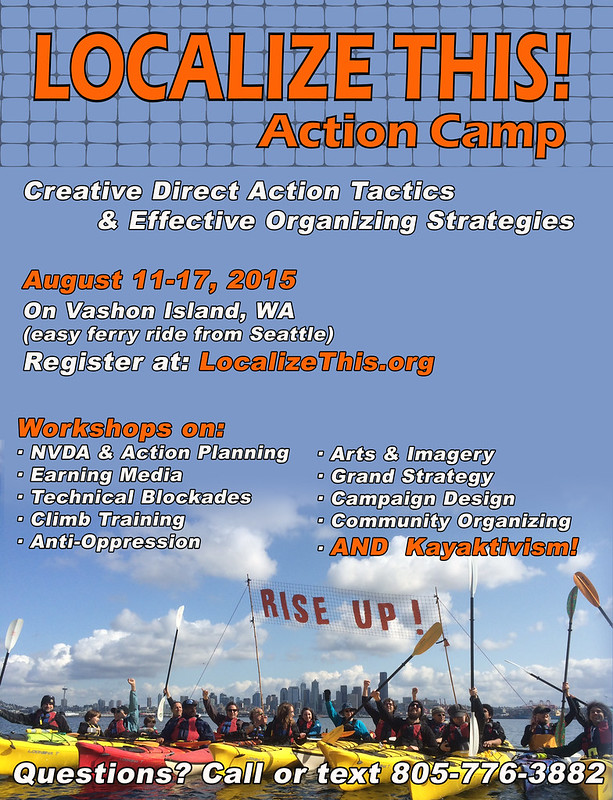
Inspired by #ShellNo actions? Backbone Campaign's "Localize This!" Action Camp brought many of those skills and relationships together. Media Island is bringing 8 people for this year's camp, contact us if you have questions or want to coordinate travel, tents, etc. This Sunday, August 2, 11-1pm, come to First Sunday Brunch, a KOWA 106.5FM benefit to learn more, 816 Adams St. SE. Contact: dj@kowalp.org, 360-352-8526

Action Camp is merely two weeks a way. . .
Have you registered yet?

Localize This!
is August 11th-17th

Register for Action Camp ->HERE<-

Register TODAY, recruit your friends, and whatever you do, make sure you don't miss Localize This! Action Camp.

What: Localize This! 2015 is YOUR destination to explore Creative Direct Action Tactics and Effective Organizing Strategies
When:
Tuesday August 11th - Monday August 17th, come a day or stay a week
Where:
Vashon, WA a beautiful, rural island across from Seattle.
Register HERE


2015 Localize This Poster

Support Joyous and Creative Interventions for Justice

What started out as training ground for a community's fight to stop a transnational corporation's environmental destruction has turned into an annual celebration of some of the best our movements for justice have to offer.

Action Camp is a valuable resource to your organizing.

Donate online HERE or send checks to PO BOX 278, Va
shon, WA 98070

Tuesday, March 11, 2014

Action Alert: Support Hunger Strikers @ NW Detention Center


CALL TO ACTION!
Today, if you can make it, head to the NW Detention Center, 1623 E J St, Tacoma, WA, to show solidarity with the detainees and to prevent the GEO Group from violently force feeding and threatening the hunger strikers. There are people there at the fence starting at noon going till 4pm, and then at 5pm and a noise demo at 8pm. Carpool from Media Island, 816 Adams St. SE, at 5pm. https://www.facebook.com/ShutdownPrisons


Urgent Action Needed

Support Hunger Strikers at the Northwest Detention Center

Sign the petition NOW!

Friends,

Your urgent support is needed. You may have read the news reports about the hundreds of detainees on a hunger strike since Friday, at the Northwest Detention Center in Tacoma, Washington.

We share this message from Maru Mora Villalpando of Latino Advocacy in Washington state:

"We have reports that more than 20 of the strikers were placed in isolation yesterday with no communications. ICE and GEO [the private prison company running the detention center] are pressuring immigrants to break the strike and harassing them verbally. We need more than 1000 signatures by tomorrow at 5PM. Please keep forwarding the petition and make sure all your contacts sign it as well.

The strikers need you!!!!!!!"

************************************

Go here to sign the petition (hosted by #not1moredeportation) by 5 pm PDT on Tuesday, March 11.

About the situation:

On Friday, March 7th, 1200 people held at the Northwest Detention Center in Tacoma, Washington, one of the largest immigration prisons in the country, began a hunger strike and work stoppage. They are putting their bodies on the line to protest the on-going deportations overseen by Immigration and Customs Enforcement and the inhumane conditions at the for-profit detention center owned and operated by the GEO Corporation.

Inspired in part by the February 24 #Not1More deportation action at the detention center, the hunger strikers timed their action to begin on Friday. On Fridays, the people facing imminent deportation are separated and processed for deportation, weekly events that contribute to the nearly 2,000,000 deported during the Obama administration. The hunger strikers join a nation-wide movement of resistance against unprecedented levels of detention and deportation.

Apart from calling attention to the unrelenting deportations, the hunger strikers demands include:

  • Improved food quality
  • Improved treatment (including medical treatment)
  • Increased pay for work in the facility (the current pay is $1.00/day)
  • An end to exorbitant commissary prices
  • Fundamental fairness and justice

People in the detention center are risking their health by not eating and withstanding potential backlash for participating in the hunger strike. Sign the petition and share widely to support the hunger strikers and their demands. Not one more deportation!

To:  Natalie Asher, Washington Field Office Director, Immigration and Customs Enforcement
CC: Daniel Ragsdale, Deputy Director, Immigration and Customs Enforcement
      John M. Hurley, Senior Vice President, GEO Corrections and Detention

I support the hunger strikers at the Northwest Detention Center and their demands. I am alarmed and disturbed by the ongoing deportations and the conditions facing those held at the Northwest Detention Center awaiting deportation.

I urge you to initiate accountable negotiations with the hunger strikers and/or their chosen representatives. I urge you to take action to implement the demands immediately, and in good faith. I also want your guarantee that hunger strikers will not face retaliation.

Add your name to the petition now!


Connect/Support:                


Thursday, August 29, 2013

[olympiaworkers] Fast food strike gets super-sized over wages

Aug. 29, 2013 CNBC

The battle to boost the minimum wage escalated Thursday when thousands of
workers at fast-food restaurants in 50 U.S. cities walked off the job to
demand a "decent" wage.

From San Diego to New York, workers stopped flipping burgers, frying
fries, and slathering on secret sauce in what organizers called the
largest strikes against the nation's fast food companies ever.

"You're trying to go up and you're just going down," said protester
Shantel Walker, 31, of Brooklyn, who makes $7.25 working at a Papa John's
(PZZA) in Manhattan. "All of us are in the same financial crunch. We're
trying to take care of our families and our livelihood."

The strikes mark the latest salvo in a nearly year-long battle to get not
only higher wages but also an opportunity to unionize without facing
retaliation from their employers. The workers' ire, too, is at the very
heart of a politicized debate to raise the country's minimum wage that
eventually may be decided in Washington.

Labor Secretary Thomas Perez told The Associated Press that the worker
strikes were a sign of the need to raise the minimum wage. "For all too
many people working minimum wage jobs, the rungs on the ladder of
opportunity are feeling further and further apart," Perez said.

At the core of the workers' demands with the $200 billion fast food
industry is salary starting at $15 an hour from the current $7.25 an hour
minimum wage and the $8.94 median wage for front-end workers.

Workers mobilized in cities from Alameda, Calif., to West Haven, Conn. and
across the nation, including several demonstrations set for New York City.
To date, strikes have been held one city or the other, or in regions, but
nothing like Thursday's national push involving hundreds of restaurants.

About 200 workers marched through the midtown Manhattan McDonald's (MCD)
on Thursday morning, and more gathered downtown in the Financial District.
As the streets became more crowded with protesters beating drums and
blowing loud whistles, police struggled to keep traffic moving.

(Read more: Earn minimum wage? It'll take this long to afford a Big Mac )

The strike comes as more and more fast food workers making minimum wage
are not teenagers, but adults trying to support families, particularly
since the Great Recession. Only 16 percent of fast food industry jobs now
go to teens, down from 25 percent a decade ago. More than 42 percent of
restaurant and fast-food employees over the age of 25 have at least some
college education, including 753,000 with a bachelor's degree or higher,
according to the Bureau of Labor Statistics.

Janul Dixon, 35, came out on Thursday to offer his support to the workers.
He used to work at Wendy's for a low wage, but has since found work as an
exterminator. "They need to allow people to make enough to support their
family," he said. "In New York everything is going up but wages are not."

The National Restaurant Association has countered that only about 5
percent of fast-food workers earn the minimum wage. Other defenders of the
industry note that increased wage costs will be passed onto consumers.

"The restaurant industry provides opportunity to over 13 million Americans
with jobs that meet critical needs within our economy. We welcome a
national discussion on wages, but it should be based on facts," said Scott
DeFife, the association's executive vice president of policy and
government affairs. "The restaurant industry is the nation's second
largest private sector employer and our industry is an industry of
opportunity."

(Read more: Minimum wage hike: Just what the economy ordered? )

"Nine out of ten salaried restaurant workers, including owners and
managers, started as hourly workers. The fact is, only 5 percent of
restaurant employees earn the minimum wage, and those that do are
predominantly working part-time and half are teenagers," DeFife added.
"Restaurant jobs teach valuable skills and a strong work ethic that are
useful for workers throughout their professional careers."

McDonald's, which has 34,000 restaurants across the globe., was quick to
defend its salaries. "McDonald's aims to offer competitive pay and
benefits to our employees. We provide training and professional
development for all of those who wish to take advantage of those
opportunities," the company said in a statement. "Our history is full of
examples of individuals who worked their first job with McDonald's and
went on to successful careers both within and outside of McDonald's." The
chain posted $5.5 billion in profits last year on revenues of $27.5
billion.

Thursday's strike was expected to be "the largest attempt at worker
organizing in this industry ever" due to support from the Service Workers
International Union, and grassroots efforts from community groups, local
politicians and the clergy, said Tsedeye Gebreselassie, an attorney at the
National Employment Law Project.

"The workers are responding to total failure on behalf of the federal
government to raise the minimum wage to keep up with inflation and the
cost of living," Gebreselassie said.

(Read more: How bad math about Big Macs gives me indigestion )

Organizers stressed the importance of the strike spreading to Southern
states.

"The South has always been the model for low wage employment, from slavery
to the Jim Crow laws, to the present," said Dorian Warren, an assistant
professor of political science at Columbia University who has published
work on labor organizing and inequality. "It's also the most anti-union
part of the country, so the fact that workers feel empowered enough to
take collective action is enormous."

Strikers complain that while revenue is up about 13 percent at fast-food
restaurants as of August, it's not being passed on to the workers.

All the media attention paid to the strikers Thursday will surely
re-ignite the minimum wage debate, in which opponents say higher
employment costs will mean fewer jobs and higher prices for customers. In
The Wall Street Journal on Thursday, the conservative Employment Policies
Institute ran a full-page ad with a picture of a robot making pancakes,
warning that higher wages would mean "fewer entry-level jobs and more
automated alternatives."

"You can either raise prices and lose customers, or (automate) those
jobs," said Michael Saltsman, EPI's research director. "The idea that
restaurants are rolling in the money is not representative of the
situation franchisees face."

Tuesday, August 13, 2013

[olympiaworkers] SeaSol quickly wins $6,710 at a South Seattle grocery store.

Aug. 13, 2013 Libcom.org

New SeaSol member Antonio worked at a grocery store in White Center for
two grueling years. Working regular 6-day, 72-hour weeks, Antonio received
no breaks, no overtime pay, and was irregularly compensated at less than
$7 per hour (far below Washington State's minimum wage). When he learned
of our win at Jumbo Buffet, Antonio got in touch with the Seattle
Solidarity Network. After much discussion and research, SeaSol and Antonio
voted to fight for 30 weeks of back wages, or $6,710, for Antonio.

On Saturday July 27th 2013, Antonio, his family, and over forty SeaSolers
filed into the store to deliver our demand. The atmosphere was tense as
the boss read the letter, shaking, and looking around at the stern faces
glaring in solidarity with Antonio. The boss was so intimidated by our
direct action that he immediately contacted a lawyer friend for help. His
lawyer called us the following Monday with weak - and quickly shut down -
attempts at bargaining.

On Thursday August 8th 2013, the thieving boss and his lawyer friend met
up with Antonio, his daughter, and other SeaSol members. More attempts to
bully Antonio into accepting less money were rejected, and Antonio was
paid $6,710 on the spot.

The unwavering position presented by SeaSol and Antonio throughout this
fight, our refusal to play legal games with a lawyer, and flawlessly
carried out direct action quickly resulted in a swift win in this fight.
Congratulations to our new comrade Antonio, and thanks to all who showed
up to the demand delivery!

[originally posted at seasol.net August 2013]

Monday, July 29, 2013

[olympiaworkers] Fast-food workers in NYC stage strikes, rallies

NEW YORK (AP) — Workers at McDonald's, Burger King and Wendy's restaurants
across New York walked out Monday in a one-day strike to demand better pay
and the right to unionize, calling for minimum wage to more than double
from $7.25 to $15 an hour and the end to what activists called "abusive
labor practices."

"It's noisy, it's really hot, fast, they rush you. Sometimes you don't
even get breaks. All for $7.25? It's crazy," said Nathalia Sepulveda, who
works at a McDonald's opposite Yankee Stadium in the Bronx, where one
protest took place.

Outside the McDonald's as well as a Wendy's in lower Manhattan, workers
chanted "we can't survive on $7.25" and "supersize our wages." At the
Wendy's, the crowd shouted at customers not to go in and two police
officers were stationed inside.

They were among hundreds of people who took part at locations throughout
New York, activists said. Similar strikes were planned across the country
this week, organized by the national Fast Food Forward campaign, which was
launched last year to tackle stagnating wages and the proliferation of
low-wage jobs as the nation recovers from the recession, said campaign
director Jonathan Westin.

"The workers' actions will lift up all of New York City," he said. "If
they have more money in their pockets, they'll spend it right here,
helping to boost the entire economy."

Doubling the minimum wage would have a "significant effect on the private
sector's ability to create jobs, especially those typically filled by
first-time workers and teens," said Scott DeFife of the National
Restaurant Association. McDonald's had directed requests for comment to
the trade group.

Spokesmen for Burger King and Wendy's both said they respect the rights of
their workers.

"We're proud that Wendy's provides a place where thousands of people with
different backgrounds and education levels can enter the workforce," said
Wendy's spokesman Bob Bertini.

Glenda Soto, 35, a single mother supporting four children said that though
she works full-time and often puts in 13-hour days at the Bronx
McDonald's, money is a constant headache.

"My rent is going up in September," she said. "We are already living
paycheck to paycheck."

Many workers brought their families with them, including children.

"We're a movement, we're a team," Sepulveda said as she held the hand of
her 3-year-old son, Hayden.

The striking workers in Manhattan were joined by politicians and community
leaders, including U.S. Rep. Jerrold Nadler, a Democrat who represents the
district. He said the fact that the fast food industry is worth $200
billion a year and yet many of its employees still rely on food stamps and
Medicaid is "disgusting."

Ashley Pinkney, who works at McDonald's in Times Square, arrived at the
downtown rally still in her uniform.

"I can't even order something off the menu with what I earn," she said.
"It makes me wonder what I'm even doing there."

Monday, July 08, 2013

[olympiaworkers] Backbone Activist Camp! What fun! You should come!

Hello Olympia! Have you been to a summer camp made just for you and your activist friends focused on creating a better world? If you have, you know it's fun, if you haven't, think Wet Hot American Summer... (It's nothing like that.) Come to Localize This! Action Camp!

Localize This Action Camp is for people who care and have a day or a week on their hands July 31- Aug. 5. Paddle, sail, swim, walk, bike or hitch a ride to Vashon Island, eat delicious food, camp under the stars (there are bathrooms and showers nearby) and learn excellent techniques to challenge the powers that spy on all your emails, put you in bottomless debt through steroidal student loans and devastates the climate of our only earth amongst other nefarious things (such as wars, Guantanamo, oppressing women, police state, etc.) that only benefit the sick 1% who control America's government and the corporations.

Register TODAY! It's a short app. If you're broke, no one is turned away for lack of funds. Register now to be counted early and let's throw a party to raise some money. Nearly every large highway banner, noisy artful action, puppet headed protest, light projection and helium filled highlight of the past 3 years seen in Oly has been a product of the skills acquired at a Backbone Campaign training. Don't miss this!

https://www.facebook.com/events/533301153379337/

July 31 is an anti-oppression training with the camp following August 1-5 in full. If you don't know how you'll get there or don't have camp gear to bring or just want to know more, email me (this is my 4th year). Lot's of fun, share this with friends and let's all meet by the campfire after days of kayaking, tree climbing, strategizing, blockade trainings and art making.

---------- Forwarded message ----------
From: Bill Moyer <bill@backbonecampaign.org>
Date: Mon, Jul 1, 2013 at 8:35 AM
Subject: Pitch in to Get Change Agents to Localize This! $5? Frequent Flyer Miles? What Can YOU Do?

If this doesn't look BEAUTIFUL then, Click Here to View Online

~~~~~~~~~~~~~~~~~~~~~~~~~~~~~~~~~~~~~~~~~~
REGISTER for Localize This! 2013 - Contribute - AND Spread the Word!

Get AMAZING Change Agents like Jeff and Ahern to Localize This! 2013 so they can share their skills with others! (like YOU)
$5? $10? Share & Tweet? Frequent Flyer Miles? What Will YOU Do?
~~~~~~~~~~~~~~~~~~~~~~~~~~~~~~~~~~~~~~~~~~

CLICK HERE: IndieGoGo Campaign for      Travel and Scholarships "Badge" Ahern Dreadsen - Direct Action, Online Media & Tactical Communications
Ahern Dreadsen - NVDA Trainer, Media Skeptic, and man of many    captivating stories
Ahern is the Direct Action trainer and Organizer of Multi Kulti in Chicago. Unity For A Change, the Activist organization of Multi Kulti, recruited him to conduct Direct Action training workshops and long-term power-building consultation with the many grassroots organizations who utilize the Co-Op. Ahern has diverse experience & accomplished a wide-range of actions from animal rescue in Hurricane Katrina, and shutting down 2 of the oldest Coal plants in Chicago with Rainforest Action Network Chicago, to long-term campaigns which have closed a corrupt police department and worked on Appalachia Rising Campaign. Ahern has worked with FIJA , "Fully Informed Jury Association" and has been deeply involved with Occupy Chicago organizing, being one of the the first two people to form their Non-Violent Direct Action Committee.
PLEASE Pitch in NOW!

Jeff Lucas - Organizer, NonViolent Direct Action Trainer & Artful Activism Innovator

Jeff Lucas - Organizer, Non Violent Direct Action Trainer, and      Artful Activism Innovator

Jeff Lucas hails from coal country in central Illinois. His introduction to activism came from his grandfather who was a 60 year rank and file member of the Industrial Workers of the World. His current focus is organizing and movement building with frontline communities in the Illinois Coal Basin, Chicago, and St. Louis. Residing in Chicago for 8 years Jeff has worked with Little Village Environmental Justice Organization, Rainforest Action Network, Action Now, Forest Ethics, United Steel Workers, Heartland Coalfield Alliance, The Alliance for Appalachia, United Food and Commercial Workers, Chicago Housing Initiative, Anarchist Black Cross, Rising Tide, Service Employees International Union, Chicago Youth Climate Coalition, Agit-Pop, Food Not Bombs, and more, and trained Students for a Free Tibet.
PLEASE Pitch in NOW!

What is Localize This!? Check out this 2 min. video

Change is not just possible, it is inevitable. But opportunity favors the prepared. There is nothing the Backbone Campaign does that is more crucial to preparing progressive change agents or weaving connections between them than our annual Localize This! Action Camp.

All year long, the Backbone team appears in our region and across the country, but only one time per year does the country come to us. For the past four years this gathering has been at the cusp of movement innovation, a source of numerous collaborations, and a spark for countless creative actions from viral Flash Mobs to Giant floating buttocks. Our giant 1% arrows banner and light projections preceded Occupy. Last year's camp lifted up Eviction Protection in the Seattle area and now our allies are celebrating a victorious Eviction Blockade. Our first camp helped save an island!

Localize This Promo VideoHERE is how you can help spread the word about the 5th annual Localize This! Artful Action Camp
  1. Please copy and SHARE/Tweet/email to friends this link http://LocalizeThis.org
  2. Invite Facebook Friends to our FB event page HERE.
  3. Download 4 per page handbill HERE.
  4. Download poster HERE.
localize this 2013 Flier


Feel free to contact the Backbone office or Bill at:
~~~~~~~~~~~~~~~~~~~~~~~~~~~~~~~~~~~~~~~~~~
~~~~~~~~~~~~~~~~~~~~~~~~~~~~~~~~~~~~~~~~~~

Friday, May 10, 2013

[olympiaworkers] Fast-food workers in Detroit walk off job, disrupt business

May 10, 2013 By Steve Neavling and Lisa Baertlein

(Reuters) - Hundreds of fast-food employees in Detroit walked off the job
on Friday, temporarily shuttering a handful of outlets as part of a
growing U.S. worker movement that is demanding higher wages for flipping
burgers and operating fryers.

The protests in the Motor City - which is struggling to recover from the
hollowing out of its auto manufacturing sector - marked an expansion in
organized actions by fast-food workers from ubiquitous chains owned by
McDonald's Corp, Burger King Worldwide and KFC, Taco Bell and Pizza Hut
parent Yum Brands Inc.

Fast-food workers, who already have taken to the streets in New York,
Chicago and St. Louis, are seeking to roughly double their hourly pay to
$15 per hour from around minimum wage, which in Michigan is $7.40 per
hour.

Organizers said more than 400 people turned out for the Detroit event, the
most to date.

They also said the walk-outs forced the temporary closures of two
McDonald's restaurants, a Burger King, a Subway, a Long John Silver's and
a Popeyes in Detroit - a claim some chains disputed.

Outside a Burger King on 8 Mile in Detroit, employee Claudette Wilson said
she's tired of poor wages, especially at a time when the fast-food
industry continues to grow.

"I make minimum wage, which is what I made when I started working in fast
food three years ago," the 20-year-old college student said. "I can't
understand how the industry is growing but our wages aren't."

Organizers said the Detroit metro area has 53,000 fast-food jobs, which
pay at or just above minimum wage.

The fast-food workforce is twice as large as that of the region's famed
auto manufacturing sector and is projected to grow faster than the
region's overall workforce in the coming years, organizers said.

"People can't make a living at $7.40 a hour," said Rev. Charles Williams
II, a protest organizer. "Many of them have babies and children to raise,
and they can't get by with these kind of wages."

Those workers face high hurdles in their fight for better pay. Low-wage,
low-skill workers lack political clout and face significantly higher
unemployment than college graduates.

U.S. President Barack Obama proposed raising the federal minimum wage in
his State of the Union address as a way to help lift some workers out of
poverty. But critics of such a move, including representatives for the
nearly $200 billion U.S. fast-food industry, say it would kill jobs by
burdening small businesses with higher costs.

PROTESTS, DISPUTES

At a Long John Silver's on Detroit's east side, a lone manager tended the
restaurant as the presence of protesters appeared to stifle business.

A McDonald's spokeswoman told Reuters its Michigan restaurants were "open,
and operating as usual". Burger King said none of its restaurants were
shut down and no workers walked off the job.

Representatives from Subway, Long John Silver's and AFC Enterprises'
Popeyes did not immediately respond to requests for comment.

Margaret Neal, 52, said frustration with the low wage she earns after more
than a decade working at a McDonald's in Detroit prompted her to join
Friday's protests.

Asked about her pay, Neal said: "You don't even want to know, I've been
there 15 years. I'm still making $8.83 (an hour). That's not right."

Neal, who works full-time, says her bosses have told her she is "maxed
out" at her current wage and ineligible for an increase.

The vast majority of McDonald's more than 14,000 U.S. restaurants are
owned and operated by franchisees. The company said in a statement that
McDonald's employees are paid competitive wages, have access to a range of
benefits and opportunities for training and career advancement.

The Detroit action was put together by the Michigan Workers Organizing
Committee, an independent union of fast-food workers, that is supported by
community, labor and faith-based groups such as the Interfaith Coalition
of Pastors, UFCW Local 876, SEIU Healthcare Michigan and Good Jobs Now.

Tuesday, March 05, 2013

[olympiaworkers] Lonmin miners strike in S.Africa, unnerving investors

Tue Mar 5, 2013 11:50am Reuters

* Wildcat strike launched as media tours mine

* Confusion sends rand, platinum, shares on bumpy ride

* Union feud at heart of dispute

By Sherilee Lakmidas

MARIKANA, South Africa, March 5 (Reuters) - Workers went on a wildcat
strike at Lonmin's Marikana platinum mine in South Africa on Tuesday,
embarrassing the company as it launched a publicity drive to try and show
it had recovered from months of deadly labour unrest.

The world's third-largest platinum producer invited journalists to tour
the mine, but the public relations exercise backfired as thousands of
workers took advantage of the media spotlight to down tools at four
shafts.

Confusion mounted after the company said they had all returned to work,
only to revise its statement when it became clear miners at two of the
shafts remained above ground.

The conflicting statements sent platinum prices, South Africa's rand and
Lonmin's shares on a bumpy ride, highlighting nerves over the health of
the country's key mining sector after months of labour unrest.

Disruptions at Marikana are particularly closely watched as it was the
site where 34 striking miners were shot dead by police last August in
South Africa's deadliest security incident since the end of apartheid in
1994.

"Things are still not right," said Johannes Liofo, a rock drill operator
at Lonmin's Karee mine. Speaking at a rock face and drenched in sweat, he
said he was still waiting for working conditions to improve.

Lonmin said workers affiliated to the Association of Mineworkers and
Construction Union (AMCU) refused to go underground on Tuesday, demanding
the closure of the offices of a rival union.

AMCU has a reputation for militancy and one of its shift bosses, Phahla
Mekela, said there was still a high level of absenteeism at the shafts,
something he attributed to widespread resentment among workers and a long
list of demands still unmet.

Lonmin spokeswoman Sue Vey said the miners had taken advantage of the
presence of the world's media to stage a stoppage and make their point.

"They made use of the opportunity to convey their message. They have been
heard," she said.

TURF WAR, ROUND TWO

AMCU Members are demanding the closure of the offices of the rival
National Union of Mineworkers because they say it is no longer the largest
body representing workers there.

The turf war between AMCU and NUM, which is a powerful political ally of
the ruling African National Congress, was at the heart of much of the
unrest that hit the platinum and gold mining sectors in South Africa last
year, triggering labour violence that killed over 50 people.

The union rivalry has shaken investor confidence in Africa's largest
economy and the world's top platinum producer and led to credit downgrades
for the country.

The rand initially fell to a session low of 9.1173 and then recovered
after the company said the strike was over. Lonmin's share price fell as
much as 2 percent in Johannesburg while platinum prices jumped over 1
percent, leap-frogging gold before easing back to parity with bullion.

Investors are also nervously monitoring union reaction to plans by Anglo
American Platinum, the world's top producer of the precious metal, to
restore profits by mothballing two mines and cutting up to 14,000 jobs.

The platinum belt northwest of Johannesburg remains a flashpoint of social
and labour tension after it was the scene of riots last year and
widespread intimidation as AMCU recruited workers angered at the NUM
leadership, which they see as out of touch with the rank and file and too
close to the ANC.

Glaring income disparities and grinding poverty in the shantytowns around
the platinum mines have also fueled the violence.

Thursday, February 28, 2013

2 rabble rousing analysts on Latin America + Israeli Apartheid Week!

Laura Carlsen, two major talks in Olympia on the Drug Wars and Neoliberalism.
1) Latin America's Challenge to Neoliberalism https://www.facebook.com/events/214326362039336
Monday, March 4, 2013 7-9pm, Olympia Center, Room 101, 222 N Columbia St, Downtown Olympia
2) A Nation at Risk: Drug Wars, Democracy, and Dependency in Mexico https://www.facebook.com/events/446797372059675
Tuesday, March 5, 2013 11am-1pm, The Evergreen State College, Seminar II, Room E1105

Laura Carlsen is a political analyst and writer who has lived in Mexico City for 25 years and is  the Director of The Americas Program, www.cipamericas.org, at the Center for International Policy,  She has written extensively on NAFTA, the drug war, immigration and gender issues in Americas Updater, Counterpunch, La Jornada and others. She is a columnist for Huffington Post and Foreign Policy in Focus, and a commentator with Al Jazeera, CCTV, NBC, Democracy Now!, NPR and Mexican television and radio stations. Laura Carlsen is co-editor of "Confronting Globalization: Economic Integration and Popular Resistance in Mexico" and has participated as an analyst and activist in the movement against militarization and the drug war on both sides of the border. Both events are free and open to the public! Sponsored by OMJP (Olympia Movement for Justice and Peace), MEChA de Evergreen and the TESC Political Economy and Social Movements Program.

EVENT: Eyewitness Updates on Honduras: Attacks on LGBTQ Community and Unions
https://www.facebook.com/events/406819922734669/
Friday, March 8, 6PM, Media Island, 816 Adams St. SE, Olympia, free event (donations accepted), food for purchase by MIJAS
Come out to hear Chuck Kaufman as he speaks about his first hand experiences organizing delegations to Honduras. Three years after the Honduras coup, Indigenous, LGBTQ, Teachers, Labor and Farmers are subjected to continual violence. The Resistance Front calls for greater international solidarity to stop the violence. This is Chuck Kaufman's final stop on a NW tour speaking on this issue, Evergreen masters student Caitlin Payne Roberts will give a recap of her experience doing solidarity work in Honduras and the delegation trip she took with Chuck. Introducing both will be Bruce Wilkinson, who traveled to Honduras 6 months after the coup and now works for Alliance For Global Justice. MIJAS will be selling food and talk about their project in honor of International Women's Day.

On June 28, 2009, democratically elected Honduran President Manuel Zelaya was rousted from his bed by the military and flown into exile. Under the coup government, and the illegitimate government of Porfirio Lobo, "selected in sham elections," violence and repression against the people of Honduras has continued to grow.

  • More than 55 small farmers, members of cooperatives farming land they are entitled to under the country's land reform laws, have been murdered by government forces and "security guards" of large landowners.
  • Thirty LGBTQ activists have been murdered, many of them tortured and mutilated first.
  • African-descended Garifuna people on Honduras' Caribbean Coast are being violently evicted to make way for tourism projects.
  • In May, four indigenous Miskito people, including two pregnant women, a 14-year old boy and a 21-year old youth were wrongfully slaughtered when a US helicopter with DEA agents aboard, negligently fired at Miskito families in a community boat. Four other indigenous family members of the boat were badly wounded. Six of the sixteen persons on the boat were children.
The US government trains and funds the Honduran military and corrupt police. It was the primary force behind recognizing the coup government and returning Honduras to membership in the Organization of American States.

Join Chuck Kaufman who has traveled to Honduras frequently since the coup to learn about the violence against marginalized communities there, how they are fighting for their economic and civil rights, and what you can do to help. Chuck Kaufman is National Co-Coordinator of the Alliance for Global Justice with 25 years of Latin America solidarity work and anti-war, anti-US militarism work in the US. He has led many delegations to Honduras since the coup and is one of the key organizers in the Honduras Solidarity Network.

AFTER the EVENT: Heartsparkle Players – Playback Theatre:  "Stories of Women Making a Better World: Their Struggles, Successes and Resilience" in recognition of International Women's Day, and in collaboration with the Olympia Fellowship of Reconciliation, 7:30, Traditions, $5-10

ALSO: Israeli Apartheid Week at The Evergreen State College
https://www.facebook.com/events/397306510366028/


You're invited to Evergreen's Second Annual Israeli Apartheid Week!

During this week, hosting by the Mideast Solidarity Project and the Olympia Movement for Justice and Peace, please join us in conversation about the Palestinian-Israeli Conflict, the nature of Israel as an apartheid system and to build Boycott, Divestment, and Sanctions (BDS) campaigns as part of a growing global BDS movement. If you don't know what BDS is, come to these events! If you aren't sure why "apartheid" is an accurate term, or disagree, come to these events! We will have current Evergreen students reporting on their recent travels in Palestine, in addition to various films and an introductory workshop. We welcome everybody--students, friends, community members, faculty, and staff. All events will have facilitated discussions after the main event.

Israeli Apartheid Week (IAW): March 4th- 8th. More info about the international movement: http://apartheidweek.org/

Sunday: Author and Activist, Remi Kanazi: Hosted by MSP and The Rachel Corrie Foundation
Time: 2-4PM workshop, 6PM poetry reading Location: the Washington State Labor Council, 906 Columbia St. SW.
https://www.facebook.com/events/288730851256532/

Monday: Intro to Israel/ Palestine
Time: 4-5 PM Location: Lecture Hall 3
https://www.facebook.com/events/539843806050493

Student Report back from Palestine
Time: 5:30- 7 PM Location: Lecture Hall 3
https://www.facebook.com/events/407730202653910

Wednesday: Film screening: Five Broken Cameras
Time: 6 Pm Location: Lecture Hall 3
https://www.facebook.com/events/506621916054946

Thursday: Film Screening: Slingshot Hip-Hop
Time: 4 PM Location: Sem 2 B1105
https://www.facebook.com/events/496086030429158

Sponsored by Mid-East Solidarity Project


###

To unsubscribe from this list: https://lists.resist.ca/cgi-bin/mailman/listinfo/mediaisland

Thursday, February 14, 2013

[olympiaworkers] Honduras: Attacks on LGBTQ & Unions; Rising Resistance Front! Speaker Chuck Kaufman, 3/8 6pm, Media Island

EVENT: Eyewitness Updates on Honduras: Attacks on LGBTQ Community and Unions
https://www.facebook.com/events/406819922734669/
Friday, March 8, 6PM, Media Island, 816 Adams St. SE, Olympia, free event (donations accepted)
Come out to hear Chuck Kaufman as he speaks about his first hand experiences organizing delegations to Honduras. Three years after the Honduras coup, Indigenous, LGBTQ, Teachers, Labor and Farmers are subjected to continual violence. The Resistance Front calls for greater international solidarity to stop the violence. This is Chuck Kaufman's final stop on a NW tour speaking on this issue, Evergreen masters student Caitlin Payne Roberts will give a recap of her experience doing solidarity work in Honduras and the delegation trip she took with Chuck. Introducing both will be Bruce Wilkinson, who traveled to Honduras 6 months after the coup and now works for Alliance For Global Justice.

On June 28, 2009, democratically elected Honduran President Manuel Zelaya was rousted from his bed by the military and flown into exile. Under the coup government, and the illegitimate government of Porfirio Lobo, "selected in sham elections," violence and repression against the people of Honduras has continued to grow.

  • More than 55 small farmers, members of cooperatives farming land they are entitled to under the country's land reform laws, have been murdered by government forces and "security guards" of large landowners.
  • Thirty LGBTQ activists have been murdered, many of them tortured and mutilated first.
  • African-descended Garifuna people on Honduras' Caribbean Coast are being violently evicted to make way for tourism projects.
  • In May, four indigenous Miskito people, including two pregnant women, a 14-year old boy and a 21-year old youth were wrongfully slaughtered when a US helicopter with DEA agents aboard, negligently fired at Miskito families in a community boat. Four other indigenous family members of the boat were badly wounded. Six of the sixteen persons on the boat were children.
The US government trains and funds the Honduran military and corrupt police. It was the primary force behind recognizing the coup government and returning Honduras to membership in the Organization of American States.

Join Chuck Kaufman who has traveled to Honduras frequently since the coup to learn about the violence against marginalized communities there, how they are fighting for their economic and civil rights, and what you can do to help. Chuck Kaufman is National Co-Coordinator of the Alliance for Global Justice with 25 years of Latin America solidarity work and anti-war, anti-US militarism work in the US. He has led many delegations to Honduras since the coup and is one of the key organizers in the Honduras Solidarity Network.

AFTER the EVENT: Heartsparkle Players – Playback Theatre:  "Stories of Women Making a Better World: Their Struggles, Successes and Resilience" in recognition of International Women's Day, and in collaboration with the Olympia Fellowship of Reconciliation, 7:30, Traditions, $5-10

-bruce
360-742-0864

Wednesday, February 13, 2013

[olympiaworkers] The machines of self-management have been switched on!

From Viome http://www.viome.org/

After 3 days of intense mobilization, the factory of Vio.Me. has started
production under workers' control earlier today! It is the first
experiment in industrial self-management in crisis-striken Greece, and the
workers of Vio.Me. are confident this is going to be only the first in a
series of such endeavors.
The march was massive and vibrant.

The mobilization kicked off with a big
assembly of the workers and solidary organizations and individuals in
a central downtown theater on Sunday evening. Here the course of
action of the solidarity movement was discussed, and everyone had the
chance to take the microphone and to express their opinion on the workers'
struggle.
Really talented artists played in support of the Vio.Me struggle.

On Monday evening there was a march in
the city center followed by a huge benefit concert with several well
known folk bands and singers. Among them Thanassis Papakonstantinou,
one of the most important contemporary Greek songwriters who is in a
sense "part of the movement" since he always supports with word
and deed the efforts of society for self-determination. The
attendance exceeded everyone's expectations. Unfortunately about a
thousand people didn't manage to get in, as the stadium was packed.
The stellar moment of the night was when the workers took the
microphone and explained their vision of another society, based on
social justice, solidarity and self-management. Five thousand people
were applauding, shouting and chanting songs of support. It was then
that everyone realized that this endeavor is bound to succeed!
One of the Vio.Me. workers addresses the people.

Early next morning the mobilization went on with a vibrant march towards
the factory. The workers were
already in their positions and the production was triumphantly
kick-started in front of the cameras of national, local and
alternative media. The workers organized a guided tour of the factory
and explained all the details of the production process to journalists
and participants in the solidarity movement.
The first batch of products produced under worker's control!

There is still a long
road ahead: The costs of production are high, access to credit is
impossible and getting a part of the market in
times of recession is uncertain. The workers are however optimistic:
The proceeds from the benefit gig and the donations of supportive
groups and individuals collected through viome.org should be
enough to keep the company afloat in the first few months. And the
support of the social movements means many of the products will be
distributed through the existing structures of social and solidary
economy. The workers of Vio.Me. are already researching new cleaning
products, based on non-toxic ecological ingredients, apt for home
use. The factory makes quality building materials (mortars, plasters,
tile adhesive paste and jointing materials, waterproof grouts, etc.)
and the workers know very well how to improve the quality even more
while lowering the production costs and hence the price. The
challenge is now to find a market for these materials, which
unfortunately are too voluminous to be transported across long
distances, and should be sold within Greece or the surrounding Balkan
countries.
The 40 workers of Vio.Me. and hundreds
of participants in the solidarity movement have for three days
lived an unforgettable experience, which however is only the start of a
long and difficult road. Now more than ever we need to be united and
strong, determined to build a new world based on solidarity, justice
and self-management!

Thursday, December 13, 2012

[olympiaworkers] Fired workers taken to court for blogging about work conditions

Dec. 11, 2012 libcom.org

Solidarity with the Workers of Natais popcorn factory in France! Exposed
to hazardous substances, forced to work on precarious conditions, the
workers tried to fight back. On Thursday, two former employees will be in
court for supposedly "defaming" their former employer!

On Thursday, December 13, 2012, former workers from the Natais popcorn
factory in Bézéril, France will go to trial for supposed „defamation" of
their ex-employer, for talking about their working conditions on a blog.

Among the problems the workers faced was exposure to Diacetyl. This
chemical can cause bronchitis obliterans, also known as „popcorn workers'
lung", or other serious respiratory illnesses. Diacetyl is a component of
the artificial butter flavor used in microwave popcorn. Bronchitis
obliterans is irreversible and can lead to death.

The workers at Natais popcorn factory are not even given masks to protect
themselves from the vapors. They also must work in extreme heat. Around
80% of the people at the factory are temporary workers. The work is hard,
people are sometimes forced to work on Sundays, the pay is bad.

There was even a strike at the factory. A year-end bonus was won, but then
the union called off the strike. Some workers however tried to keep
fighting. For trying to speak out against these conditions, a case was
brought against 2 of the strikers, now former workers of the company.

We call on comrades around the world to support this case by sending an
email to the company. info@popcorn.fr

Sample text: We demand an end to the repression of Natais workers and
support their struggle for safer working conditions and job security. (Add
whatever you like to text.)

You can also BCC or forward your mail to sia32@no-log.org, the local union
in Gers which has been involved.

Some leaflets and more information in different languages is available
here: http://www.zsp.net.pl/natais

Monday, December 03, 2012

[olympiaworkers] Los Angeles port strike triggers fears, lobbying by businesses

(Reuters) - A national coalition of U.S. business groups is urging an end
to a strike at the twin California ports of Los Angeles and Long Beach
amid fears that a prolonged stand-off will cost the American economy many
billions of dollars, and could even spread to the east coast.

Trade groups led by the National Retail Federation have sent letters to
U.S. President Barack Obama and leading members of Congress asking them to
intervene and help end the strike at America's two busiest container
harbor facilities. Those industry groups say the strike, which entered its
sixth day on Sunday, is already costing $1 billion a day.

The labor dispute has been triggered by 500 clerical workers at the ports,
members of the relatively small Office of Clerical Union Workers. Their
industrial action and clout has been significantly strengthened because
some 10,000 members of the International Longshore and Warehouse Union
have supported them, refusing to cross the clerical workers' picket lines.

Their action has effectively shut down 10 of the two ports' combined 14
container terminals. Four other container terminals have remained opened,
along with facilities for handling break-bulk cargo such as raw steel and
tanker traffic.

Industry groups say they have fresh memories of a 10-day lockout at West
Coast ports in 2002. They estimate that dispute cost the U.S. economy $1
billion a day and that it took six months before the supply chains fully
recovered.

Groups are also warily monitoring an ongoing labor dispute between the
International Longshoremen's Association and the U.S. Maritime Alliance
which could affect ports from Maine to Texas.

The employment contract between the two groups expired at the end of
September without a new agreement. The contract was temporarily extended
for 90 days, until the end of this year. A federal mediator has stepped in
to oversee negotiations to try an avert a strike that would hit at least
14 ports along the East and Gulf coasts.

"Our members are very nervous and very upset about the impact of the (Los
Angeles) strike on their businesses," said Jonathan Gold, vice president
of supply chain and customs policy at the National Retail Federation.

"We have had a lot of feedback. They have very fresh memories of what
happened in 2002 and what is happening on the east coast."

Gold said his organization has been working with groups including the
American Apparel and Footwear Association, the Retail Industry Leaders
Industry Association and the Harbor Truckers Association to pressure
lawmakers in Washington to end the stand-off.

The NRF sent a letter to Obama last week asking him to intervene. Barbara
Boxer and Diane Feinstein, California's two Democratic senators, have also
urged both sides to resolve the dispute.

Negotiations ran late into Saturday and continued Sunday. The clerks had
been without a contract for more than two years when labor talks with
management broke off on Monday. The chief stumbling block has been the
future of union representation for jobs that are lost through retirement.

ILWU leaders are demanding that jobs traditionally performed by their
members remain classified as union work and subject to the union's
contract terms, even after individuals holding those jobs retire. They
accuse the management of seeking to outsource union clerical jobs to
overseas workers paid far less in wages and benefits.

The Port of Los Angeles, the nation's busiest container harbor facility,
and second-ranked Long Beach together handled more than $400 billion in
goods arriving or leaving the West Coast by ship, L.A. port spokesman
Philip Sanfield said.

Sunday, November 25, 2012

[olympiaworkers] Fire kills 112 workers at Bangladesh garment-maker

Nov. 25, 2012 Associated Press

DHAKA, Bangladesh (AP) — Fire raced up the floors of a garment factory in
Bangladesh, killing at least 112 people, many of them trapped in the
eight-story building with no emergency exits where they make clothes for
major global retailers.

The factory outside the capital, Dhaka, is owned by Tazreen Fashions Ltd.,
a subsidiary of the Tuba Group, which makes products for Wal-Mart and
other companies in the U.S. and Europe.

Firefighters recovered at least 100 bodies from the factory and 12 more
people died at hospitals after jumping from the building to escape, Maj.
Mohammad Mahbub, fire department operations director, told The Associated
Press on Sunday.

Local media reported that up to 124 people were killed. The cause of the
blaze that began late Saturday was not immediately clear, and authorities
ordered an investigation.

Army soldiers and border guards were helping keep order as thousands of
onlookers and anxious relatives of the factory workers gathered, Mahbub
said.

Tazreen was given a "high risk" safety rating after a May 16, 2011, audit
conducted by an "ethical sourcing" assessor for Wal-Mart, according to a
document posted on the Tuba Group's website. It did not specify what led
to the rating.

Wal-Mart spokesman Kevin Gardner said online documents indicating an
orange or "high risk" assessment after the May 2011 inspection and a
yellow or "medium risk" report after an inspection in August 2011 appeared
to pertain to the factory. The August 2011 letter said Wal-Mart would
conduct another inspection within one year.

Gardner said it was not clear if that inspection had been conducted or
whether the factory was still making products for Wal-Mart.

If a factory is rated "orange" three times in two years, Wal-Mart won't
place any orders for one year. The May 2011 report was the first orange
rating for the factory.

Neither Tazreen's owner nor Tuba Group officials could be reached for
comment.

The Tuba Group is a major Bangladeshi garment exporter whose clients also
include Carrefour and IKEA, according to its website. Its factories export
garments to the U.S., Germany, France, Italy and the Netherlands, among
other countries. The Tazreen factory, which opened in 2009 and employed
about 1,700 people, made polo shirts, fleece jackets and T-shirts.

Bangladesh has some 4,000 garment factories, many without proper safety
measures. The country annually earns about $20 billion from exports of
garment products, mainly to the U.S. and Europe.

In its 2012 Global Responsibility report, Wal-Mart said that "fire safety
continues to be a key focus for brands and retailers sourcing from
Bangladesh." Wal-Mart said it ceased working with 49 factories in
Bangladesh in 2011 because of fire safety issues, and was working with its
supplier factories to phase out production from buildings deemed high
risk.

At the factory, relatives of the workers frantically looked for their
loved ones. Sabina Yasmine said she saw the body of her daughter-in-law,
but had seen no trace of her son, who also worked there.

"Oh, Allah, where's my soul? Where's my son?" wailed Yasmine, who works at
another factory in the area. "I want the factory owner to be hanged. For
him, many have died, many have gone."

Mahbub said the fire broke out on the ground floor, which was used as a
warehouse, and spread quickly to the upper floors. Many workers who
retreated to the roof were rescued, he said. But he said that with no
emergency exits leading outside the building, many victims were trapped,
and firefighters recovered 69 bodies from the second floor alone.

"The factory had three staircases, and all of them were down through the
ground floor," Mahbub said. "So the workers could not come out when the
fire engulfed the building."

"Had there been at least one emergency exit through outside the factory,
the casualties would have been much lower," he said.

Many victims were burned beyond recognition. The bodies were laid out in
rows at a school nearby. Many of them were handed over to families;
unclaimed victims were taken to Dhaka Medical College for identification.

Prime Minister Sheikh Hasina expressed shock at the loss of so many lives.

The Bangladesh Garment Manufacturers and Exporters Association said it
would stand by the victims' families.

Friday, November 16, 2012

[olympiaworkers] Wal-Mart files U.S. labor charge against union

(Reuters) - Wal-Mart Stores Inc is taking its first legal step to stop
months of protests and rallies outside Walmart stores, targeting the union
that it says is behind such actions.

Wal-Mart filed an unfair labor practice charge against the United Food and
Commercial Workers International Union, or UFCW, asking the National Labor
Relations Board to halt what the retailer says are unlawful attempts to
disrupt its business.

The move comes just a week before what is expected to be the largest
organized action against the world's largest retailer, as a small group of
Walmart workers prepare to strike on Black Friday, typically the busiest
shopping day of the year.

"We are taking this action now because we cannot allow the UFCW to
continue to intentionally seek to create an environment that could
directly and adversely impact our customers and associates," Wal-Mart
spokesman David Tovar said on Friday. "If they do, they will be held
accountable."

The union is undeterred. "Walmart is grasping at straws," said UFCW
Communications Director Jill Cashen. "There's nothing in the law that
gives an employer the right to silence workers and citizens."

Protests and rallies outside Walmart stores around the country and other
actions such as flash mobs have been orchestrated by groups including OUR
Walmart, a coalition of thousands of current and former Walmart workers
that wants to collectively push for better wages, benefits and working
conditions.

"Wal-Mart is in effect firing a shot across the bow of the UFCW,
essentially saying 'Look, you can expect this and more unless you
desist,'" said Harley Shaiken, a professor at the University of
California, Berkeley, who specializes in labor issues.

Filing with the NLRB suggests that the protests have caught the attention
of Wal-Mart, which has no union-represented workers in the United States.

OUR Walmart and another group, Making Change at Walmart, are affiliated
with the UFCW, which represents more than 1 million workers including many
at retailers that compete with Walmart. According to a filing with the
Labor Department, OUR Walmart was a subsidiary of the UFCW as of 2011.

Walmart worker and OUR Walmart member Mary Pat Tifft told Reuters that OUR
Walmart is an independent organization that gets technical support from
the union but that the UFCW has no stake or controlling interest in the
group.

"The fact that Wal-Mart is responding in such a public way is itself both
unusual and indicative that they truly don't want to see this spread,"
Shaiken said.

The NLRB typically receives a charge and investigates. At times, it
resolves issues without issuing a complaint, spokesman Tony Wagner said.
While most investigations take about six weeks, they can be expedited
under certain criteria, he said.

Activities over the past year or longer "have caused disruptions to
Walmart's business, resulted in misinformation being shared publicly about
our company, and created an uncomfortable environment and undue stress on
Walmart's customers, including families with children," Walmart outside
counsel Steven Wheeless said in a letter sent on Friday to Deborah Gaydos,
assistant general counsel of the UFCW.

PICKETING PROHIBITED

The National Labor Relations Act prohibits such picketing for more than 30
days without the filing of a representation petition. The NLRA also
requires the NLRB to seek a federal court injunction against such
activity, the letter states.

The OUR Walmart group of current and former Walmart employees has been
organizing 1,000 protests including strikes and what it called online
actions that began this week and will culminate on Black Friday.

For example, workers walked off the job in Seattle on Thursday and in
Dallas on Friday, OUR Walmart said.

Bentonville, Arkansas-based Wal-Mart said that anyone who is not an
employee is prohibited from coming onto its owned or controlled parking
lots or other facilities to solicit, hand out literature or otherwise
engage in any demonstration.

Wal-Mart said that it intends for the UFCW to be held accountable for any
injury or property damage that may occur as a result of the actions led by
the union, OUR Walmart or any of its other affiliates.

Past attempts to unionize Walmart U.S. workers have failed. In 2005, Tire
and Lube Express department workers at stores in New Castle, Pennsylvania,
and Loveland, Colorado, voted against representation by the UFCW.

OUR Walmart is not a union, though the thousands of Walmart employees it
says are members do pay $5 monthly dues.

Wal-Mart has 1.4 million U.S. workers. Of 5 million job applications
Walmart U.S. received in 2011, 20 percent of the workers it hired were
coming back to the company. The turnover rate among Walmart U.S.
employees, 37.26 percent in 2011, was below the industry average of 43.6
percent, it says.

"We just don't think what the unions have to offer is a better deal for
our associates," said Wal-Mart's Tovar.

Wal-Mart filed its charge against the UFCW late on Thursday with the NLRB
regional office in Little Rock, Arkansas. The case number is 26-CB-093342.

For copies of Wal-Mart's letter to the UFCW and the NLRB charge document
click http://bit.ly/Qj5c0t and http://bit.ly/RZoNkD

For copies of Wal-Mart's letter to the UFCW and the NLRB charge document
click http://bit.ly/Qj5c0t and http://bit.ly/RZoNkD

(Reporting by Jessica Wohl in Chicago. Additional writing by Phil Wahba in
New York; Editing by Tim Dobbyn and Leslie Gevirtz)

Monday, November 12, 2012

[olympiaworkers] Hostess closing Seattle bakery following strike

Mon, 11/12/2012

Hostess Brands Inc. is permanently closing three bakeries following a
nationwide strike by its bakers union.

The maker of Twinkies, Ding Dongs and Wonder Bread said Monday that the
strike has prevented it from producing and delivering products, and it is
closing bakeries in Seattle, St. Louis and Cincinnati. The facilities
employ 627 workers.

Hostess, based in Irving, Texas, operates 36 bakeries nationwide and has
about 18,300 employees. It warned earlier this month that the strike, by
about 30 percent of its workforce, could lead to bakery closures.

"We deeply regret this decision, but we have repeatedly explained that we
will close facilities that are no longer able to produce and deliver
products because of a work stoppage - and that we will close the entire
company if widespread strikes cripple our business," Hostess Brands CEO
Gregory F. Rayburn said.

Hostess said customers will not be affected by the closures.

A representative for the union could not be reached immediately for
comment Monday.

Thousands of members of the Bakery, Confectionery, Tobacco Workers and
Grain Millers International Union went on strike Nov. 9 to protest cuts to
wages and benefits under a new contract offer, which the union rejected in
September. Union officials say the company stopped contributing to
workers' pensions last year.

Hostess has argued that workers must make concessions as it tries to
improve its financial position. The privately-held food maker filed for
Chapter 11 protection in January, its second trip through bankruptcy court
in less than a decade. Hostess cited increasing pension and medical costs
for employees as one of the drivers behind its latest filing.

The company, founded in 1930, is fighting battles beyond labor costs,
however. Competition is increasing in the snack space and Americans are
increasingly conscious about healthy eating.

Tuesday, October 30, 2012

[olympiaworkers] European-wide general strike November 14 - how real? How relevant?

http://libcom.org/blog/european-wide-general-strike-november-14-how-real-how-relevant-22102012

In at least four countries, there will be a general strike on November 14.
There are calls to turn it into a European general strike. What to make of
the idea, how to operate most fruitfully in connection to these and
similar initiatives, is the subject of this article.

November 14 will – at the very least – see strike action against austerity
in four European countries: Spain, Portugal, Greece and Cyprus. (1) There
is the potential of much, much more, and people from very diverse
backgrounds are working in the direction of en Europe-wide general strike
on that day. Does it make sense? How can we contribute in such ways that
N14 – as the date is beginning to be called – can become much more than
yet another mostly symbolic action such as we have been seeing many times
already?

First, the situation itself. Trade union federations have called
nationwide one day general strikes for November 14 in the four countries I
mentioned. Apparently, union federations in France and Italy are
considering the idea as well. Let's be clear on the importance of this.
Union federations do not launch these kind of strikes because they want
serious resistance to austerity. Rather, they want these strikes as a show
of force to strengthen their own positiaon as mediators of the class
struggle, as managers of discontent. They want to show governments and
bosses: hey, there is a lot of discontent amongst workers. We will try to
hold it in check for you; it is our (rather well-paid) job. But you have
to give some concessions, you have to soften your stance on austeriry a
bit. Only that will enable us to play our role, ony then we can say to our
members: trust us, don't rock the boat, we will bring about some
improvements. To show governments that the trade union leaders have to be
taken into account, trade union leaders call their members to strike, as
if to say to govermnent: do you see all these angry workers? Do you feel
the disruption they cause, for just one day? Now, do you appreciate our
trouble to keep them quiet? Please help us doing so, by giving us
concessions to increase our credibility among these workers. Or would you
rather have these workers pushing us aside and fighting on their own
terms? Would you rather have strtikes without fixed duration, wildcat
strikes, all-out class confrontation?

These strikes, then, are entirely bureaucratic in their motivation, as far
as trade union functionaries are concerned. Workers, however, tend to see
them as opportunities to show their anger, and make their anger felt.
Rightly so! For radicals, that makes them relevant. The more a strike call
is supported, in as militant a fashion as possible, the stronger workers
will feel, the stronger ties of solidarity will be built.. In itself, this
does not stop governments or austerity policies. But it builds working
class strength and confidence needed for a serious struggle. Trade union
leaders use these kind of strikes to parade workers as their stage army.
Radical workers, anarchists among them, want to see the soldiers of that
army starting to fight on their own account, turning the stage army in an
independent force fighting from below. That is whay libertarian communists
should, in my view, take these strike calls seriously. Not because we
trust the trade unions, but on the contrary, because we doe not trust
them, and refuse to leave the struggle in their iron grip.

The general strikes on N14 will not, in themselves, stop austerity or
bring down governments. Even a one day European strike will not do that.
Greece has seen 20 general strikes of this type. Yet, the government did
neither fall nor budge because of that. One can say that, without the
discontente expressed through thesee strikes, the Greek goverment and the
EU bureaucrats would feel even more arrogantly confident to push on; in
that sense, the strikes may have acted as a brake. But it is clear that to
beat back austerity, a much more offensive approach – ongoing strikes,
occupations, street blockades, confrontation with the state – will be
needed (2). But the mobilizations around the strikes can be used as
stepping stones in that direction. The same applies to the European wide
strike action now being organized and discussed for N14. And yes, when you
are striking in Spain in the knowledge that workers in Greece, Portugal
and Cyprus (and Italy? And France? And... ?) are out on strike, it
probably raises your confidence, making you feel part of an even bigger
whole. So yes, by all means, let's support the European-wide general
strike – in our own independent fashion. It is not at all the magic trick
to end our problems. But we can use it as part of building our fight – and
spreading our ideas within the fight.

How? I have not very much to say here about the specifics of struggle in
Spain, Portugal, Cyprus and Greece. The general idea is clear: making the
strike as forceful as possible, challenging the top-down union
bureaucratic grip on events, connecting with ongoing struggles,
introducing direct-action dynamics within and around the strike and
connected demonstrations. For instance, the anti-austerity protest
organized in Londen last Saturday was by trade unions along familiar,
bureaucratic, blowing-off-steam-and-then-go-home lines. However, as
mentioned in "What October 20 tells us about the state of the movement",
on Libcom (3), Disabled People Against Cuts held a beautiful street
blockade with wheelchairs as part of the action which raised the
temperture and added to the pressure. Initiatives like these can make
mobilizations much more forceful than trade union organizers intend them
to be. Radicals in the countries where the strike is on will find their
way.

There are, however countries where ther is no general strike call from
trade union circles in sight. The Netherlands is one of these countries.
Yes, ETUC, the European trade union federation, has made a call for "a day
of action and solidarity on 14 November, including strikes,
demonstrations, rallies and other actions." (4) Not quite a call for a
general strike, but a step in that direction. The purpose: "mobilising the
European trade union movement behind ETUV policies as set down in the
Social Compact for Europe". Whatever is in that document, people will
understand this call as a protest against the European-wide austerity
policies, at least in their current form. Just like national general
strike calls can be used to mobilize around in the direction of a more
radical approach, the ETUC call can be used to build in the direction of
European-wide strike action and more. This is what people, myself
included, are trying to do in the Netherlands.

It is important to do it right, however. There is the temptation to get
stuck on trade union territory, to just take the ETUC call, step to the
unions and demand that they organize strike action, imploring them,
pressurizing them, leaving it up to them. This is the approach that
Trotskyists use in Britain: demanding that the TUC organize a general
strike. Lenin's Tomb expresses the idea: "there is a basis for mass
industrial action to happen if only the trade unions are willing to
support it." (5) Ah, if only! They will solve the problem for us! And what
if they don't? Wait for better days and Sell the Paper? I think a much
more fruitful approach can and should be tried. The idea of e a general
strike on a European scale can be pushed by radical circles, whether
anarchists, Occupy-related networks, other formal or informal netwerks of
radicals.

For the day itself, street actions can be planned, noisy pots-and-pans
protest marches ans assemblies like in Quebec last summer, blockades of
buildings where hated, austerity-related institutions are seated,
'ordinary' demonstrations, pickets at embassies of states where general
strikes are going forward. People might spontaneously get sick of
austerity on that 14th of November as well. Anything to express solidarity
with the struggle against austerity. Anyything to raise the anti-austerity
temperature. And all exoplicitly connected to the general strike idea for
N14. And who knows, there might just be an office department, a factory, a
company, where workers are already so fed up and confident that they might
come out on strike. There might even be a trade union branch or wing here
and there that is sensitive to the mood, and starts supporting the idea.
You never know how far you come unless you try. However, our approach
should not make itself depend on that unions will or will not do.
Independent initiative and organization from the bottom up, are essential.
Waiting for the unions would be catastrophic and, more importantly, it is
entirely unneccessary.

The idea has been tried before. On May Day this year, calls went out in
the US for a general strike. Occupy- and related initiatives spread the
call, and organized street protests on that day. No, it was not a general
strike. But is spread the idea of such a strike, and it was a step in that
direction. No, a combination of the actions that I mentioned for N14 will
very likely not amount to a full general strike, it may not even come
close. But it would spread the idea that strike action is needed and
should be built, it would be a step in the right direction. And maybe it
could become a dress rehearsal for something much bigger as well, on the
First May 2013...

[1] "Anti-Austerity Allies Coming Together for Cordinated European
Strikes", Common Dreams, 19 oktober 2012,
[2] The insights that Thrasybulus expresses in "General strike: Round 20",
on Libcom.org, are vital here.
[3] Phil, "What October 20 tells us about the state of the movement",
Libcom.org, 21 October.
[4] ETUC, "ETUC day of action and solidarity for a Social Compact for
Europe" , October 17
[5] "Mass protests against the cuts", Lenin's tomb, October 20.

For this article, the forum thread on Libcom, "European general strike? 14
November" , has been very useful.